

HDMI Matrix Switchers | 8K HDMI 2.1, 4K HDMI 2.0, HDBaseT Extension
HDMI 2.1 Matrix Switchers with Audio De-Embedding


Basic HDMI Matrix Switchers
HDMI Matrix Switchers with HDBaseT Extension
HDMI Matrix Switchers with Downscaling
HDMI Matrix Switcher Selection Guide
Filter VigilLink's HDMI matrix range by bandwidth or capability to find the right switcher, extension, or downscaling matrix.
Showing 12 of 12 products
| Product | Size | HDMI / Bandwidth | Extras | Best for |
|---|---|---|---|---|
| HDMI 2.1 — Audio De-Embedding | ||||
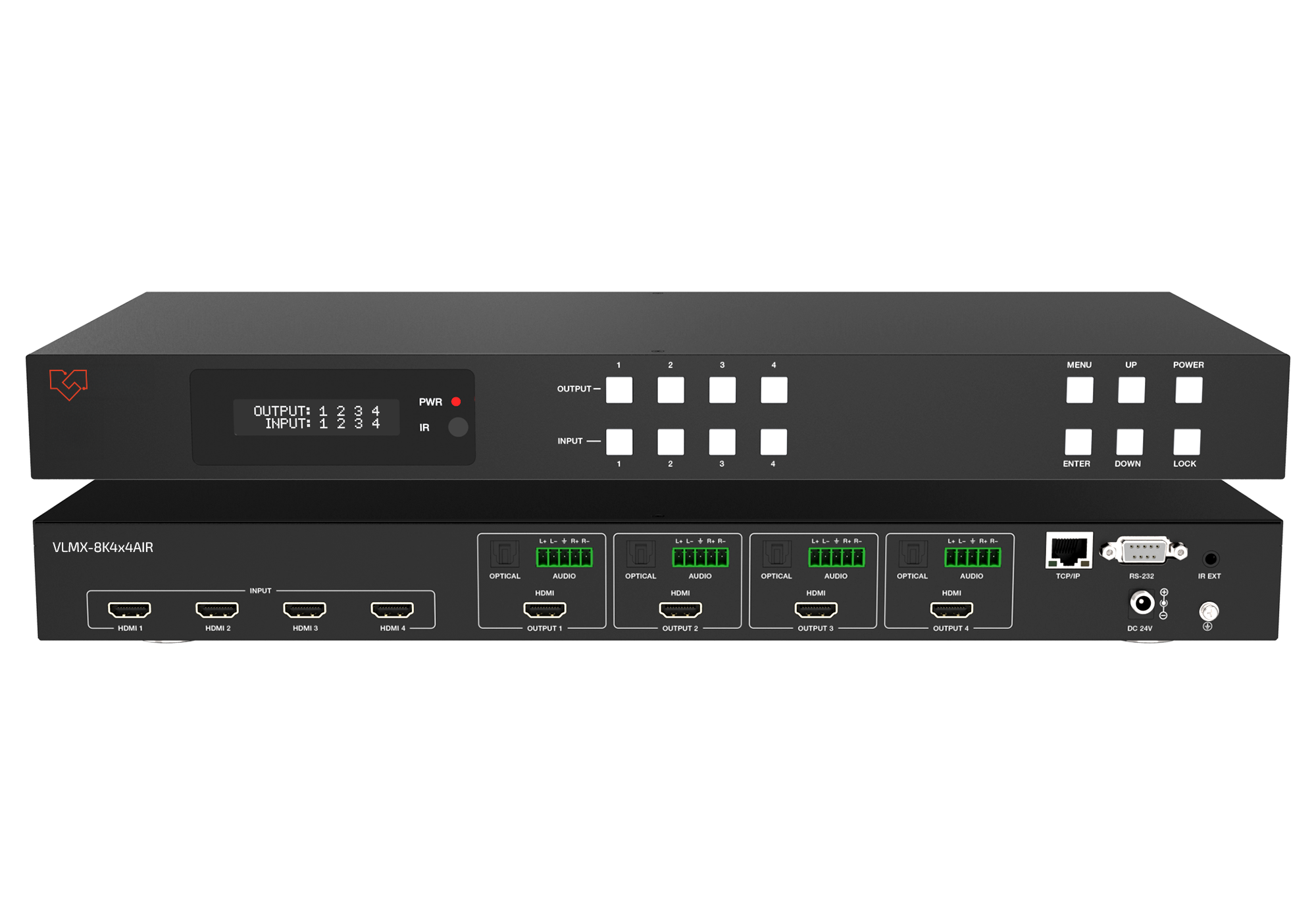
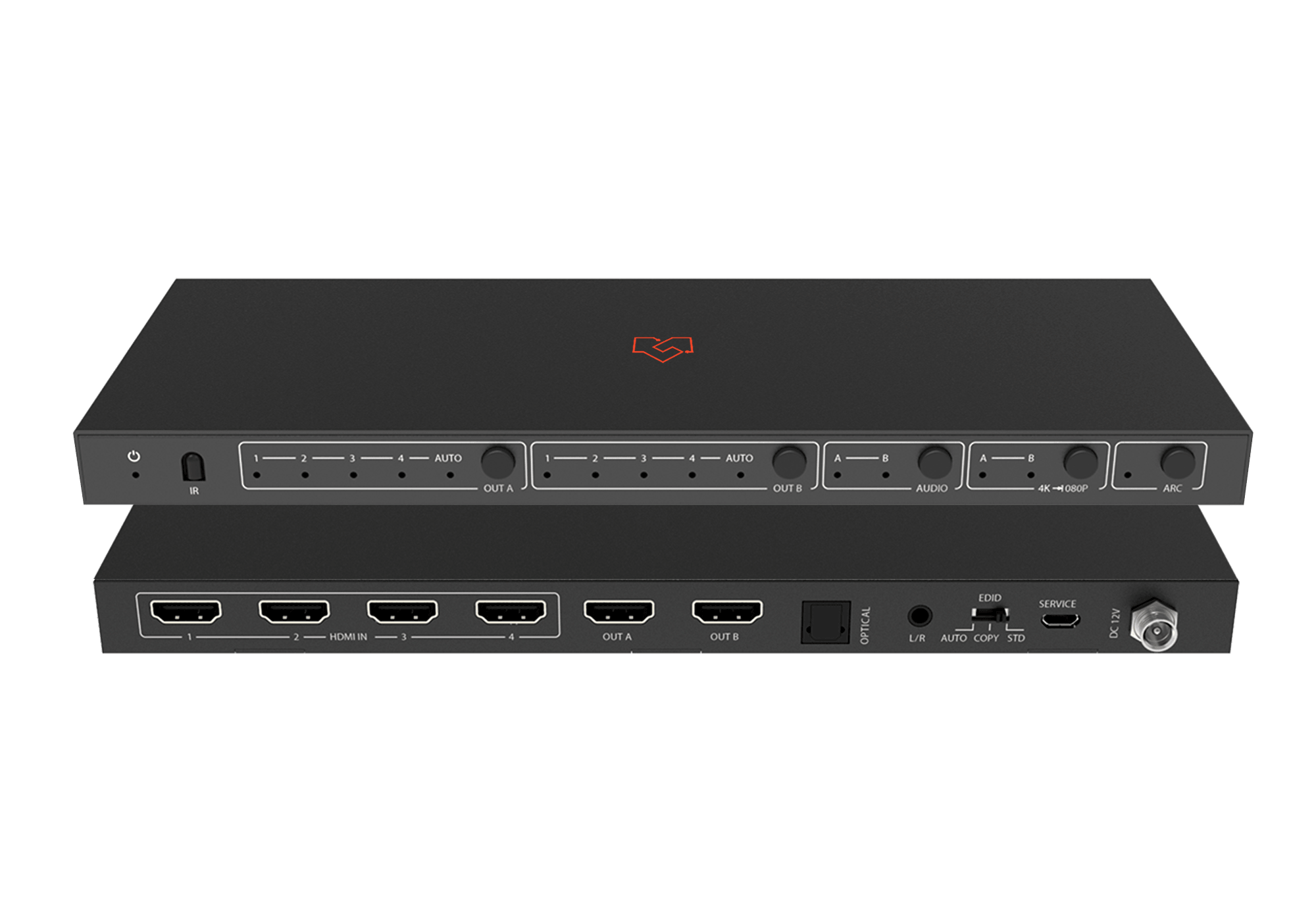
| VLMX-8K4x4AIR | 4x4 | HDMI 2.1, 48Gbps, HDCP 2.3 | 8K@60 4:2:0 / 4K@120 4:4:4, full gaming feature set (VRR/ALLM/QMS/QFT/SBTM), per-output audio de-embed, 8K-to-4K/1080p downscale, HDR-to-SDR | 8K-ready installations and gaming environments needing per-display independent audio routing |
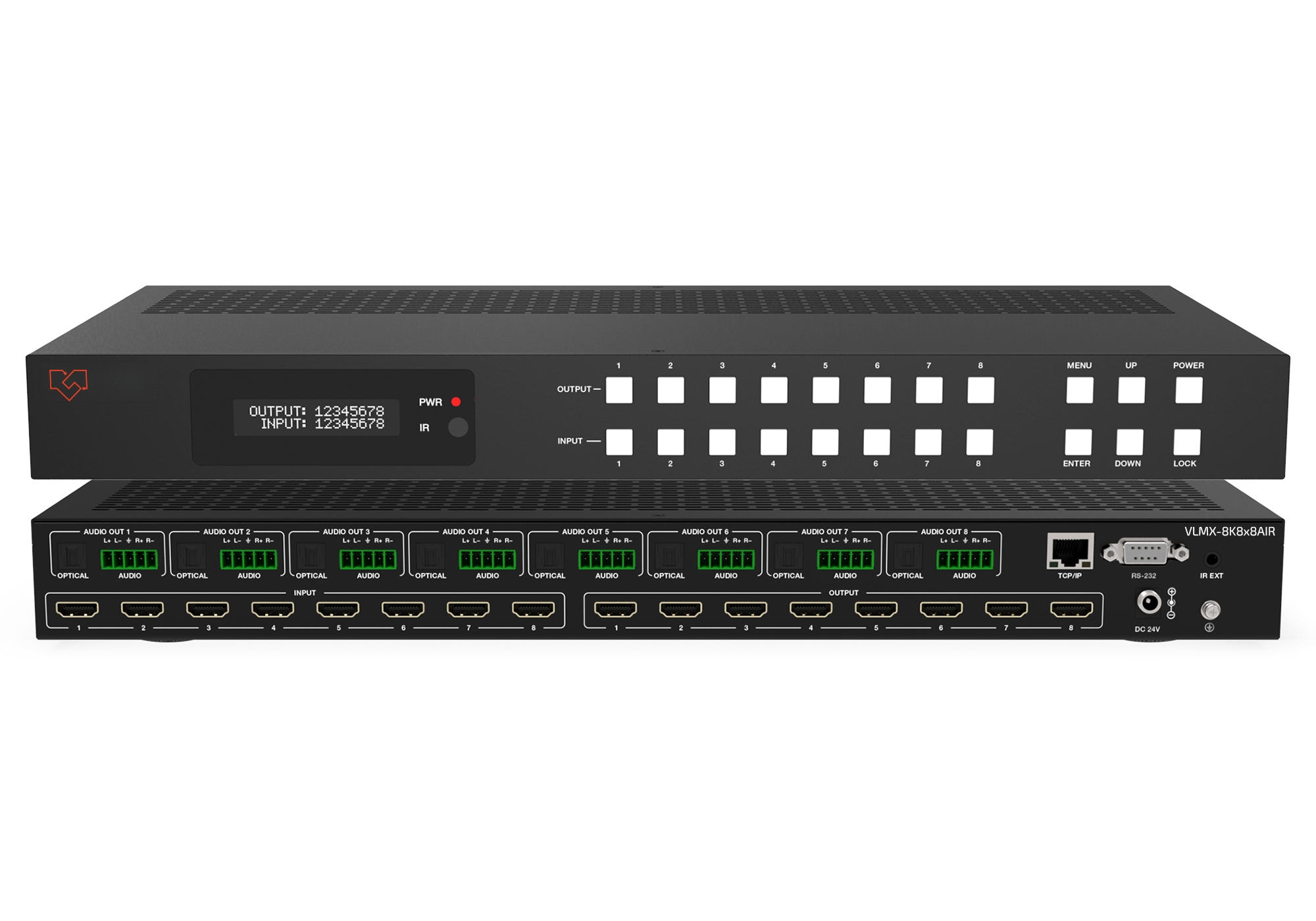
| VLMX-8K8x8AIR | 8x8 | HDMI 2.1, 48Gbps, HDCP 2.3 | 8K@60 4:2:0 / 4K@120 4:4:4, full gaming feature set (VRR/ALLM/QMS/QFT/SBTM), per-output audio de-embed, 8K-to-4K/1080p downscale, HDR-to-SDR | Larger 8K-ready installations needing per-display independent audio routing at scale |
| Basic HDMI Matrix (HDMI 2.0) | ||||
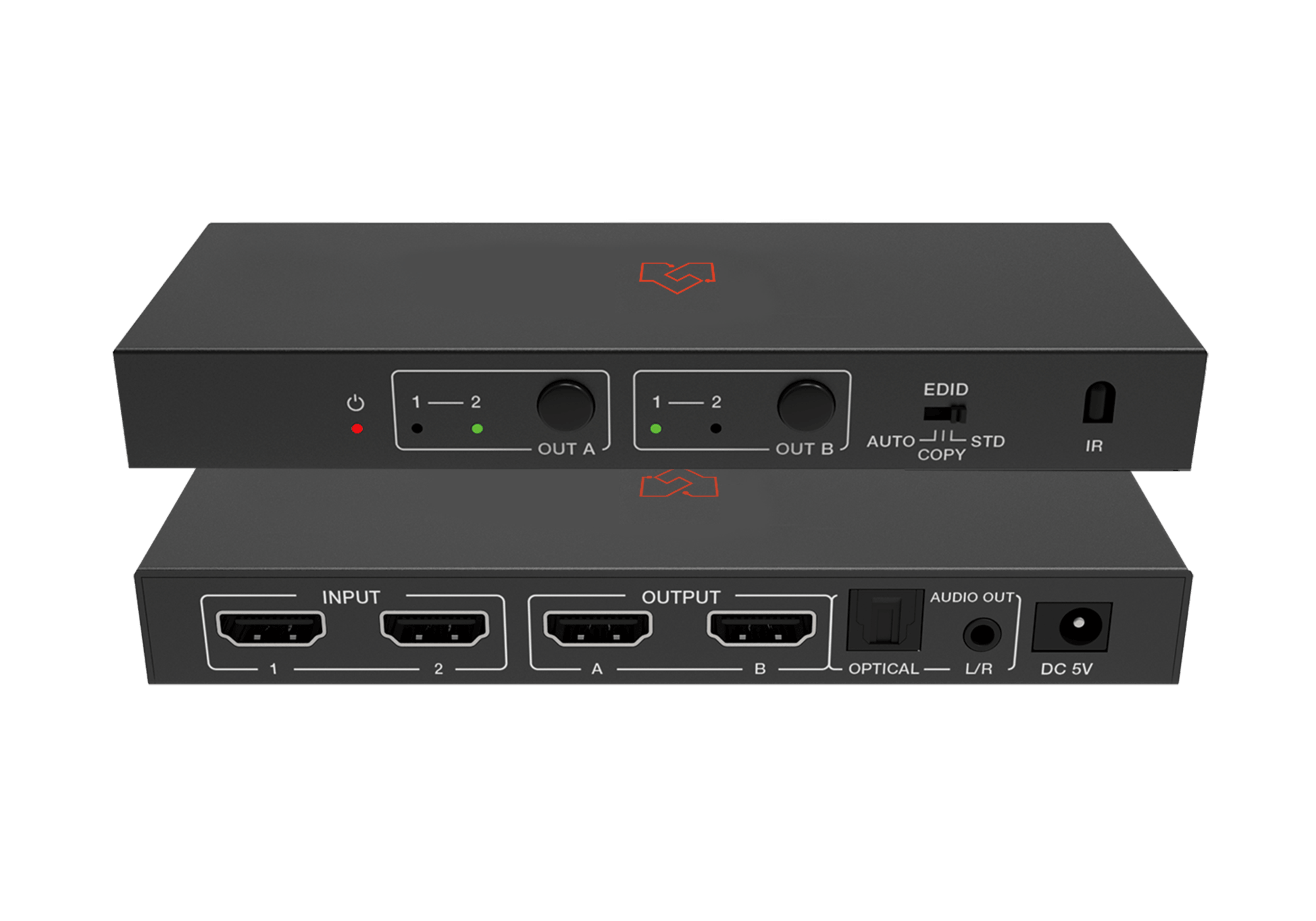
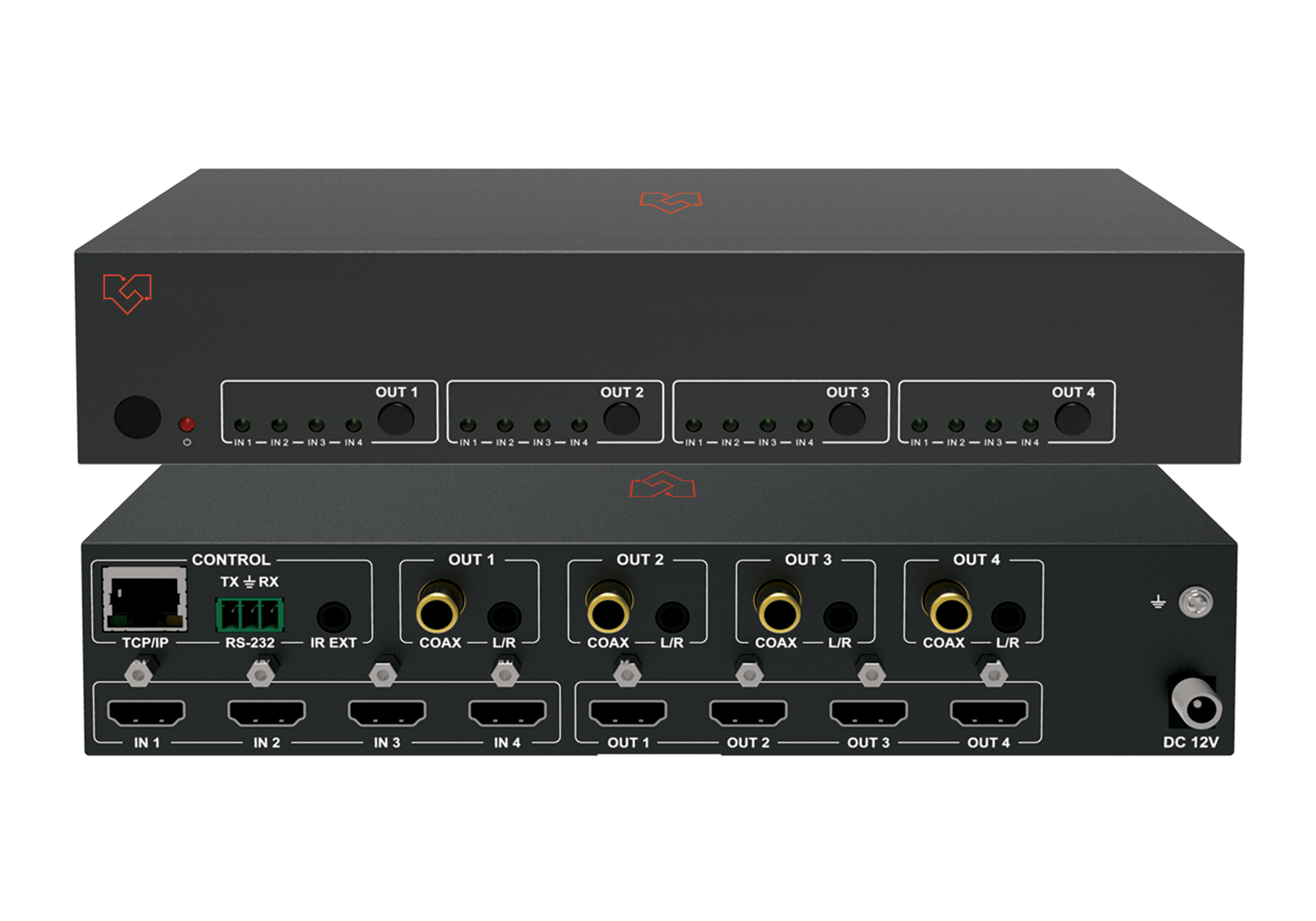
| VLMX-0202E | 2x2 | HDMI 2.0, 18Gbps, HDCP 2.2 | Pure switching, no extension or downscaling | Small co-located rack-to-display routing with two sources and two displays |
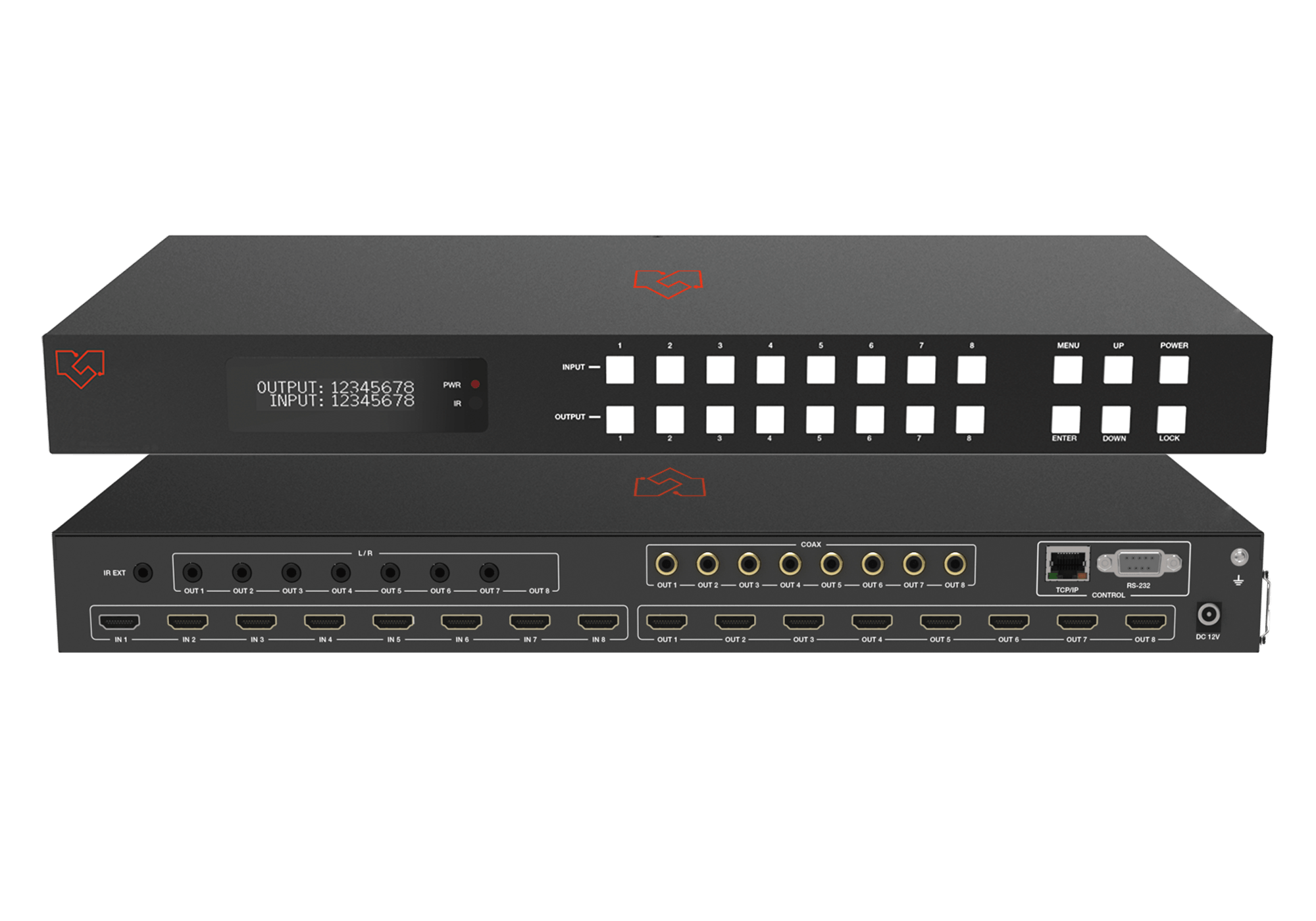
| VLMX-0808E | 8x8 | HDMI 2.0, 18Gbps, HDCP 2.2 | Pure switching, no extension or downscaling | Mid-size control rooms and broadcast racks needing co-located any-to-any routing |
| VLMX-1616E | 16x16 | HDMI 2.0, 18Gbps, HDCP 2.2 | Pure switching, no extension or downscaling | Large-scale broadcast control rooms and campus AV needing maximum co-located port count |
| HDMI 2.0 — HDBaseT Extension | ||||
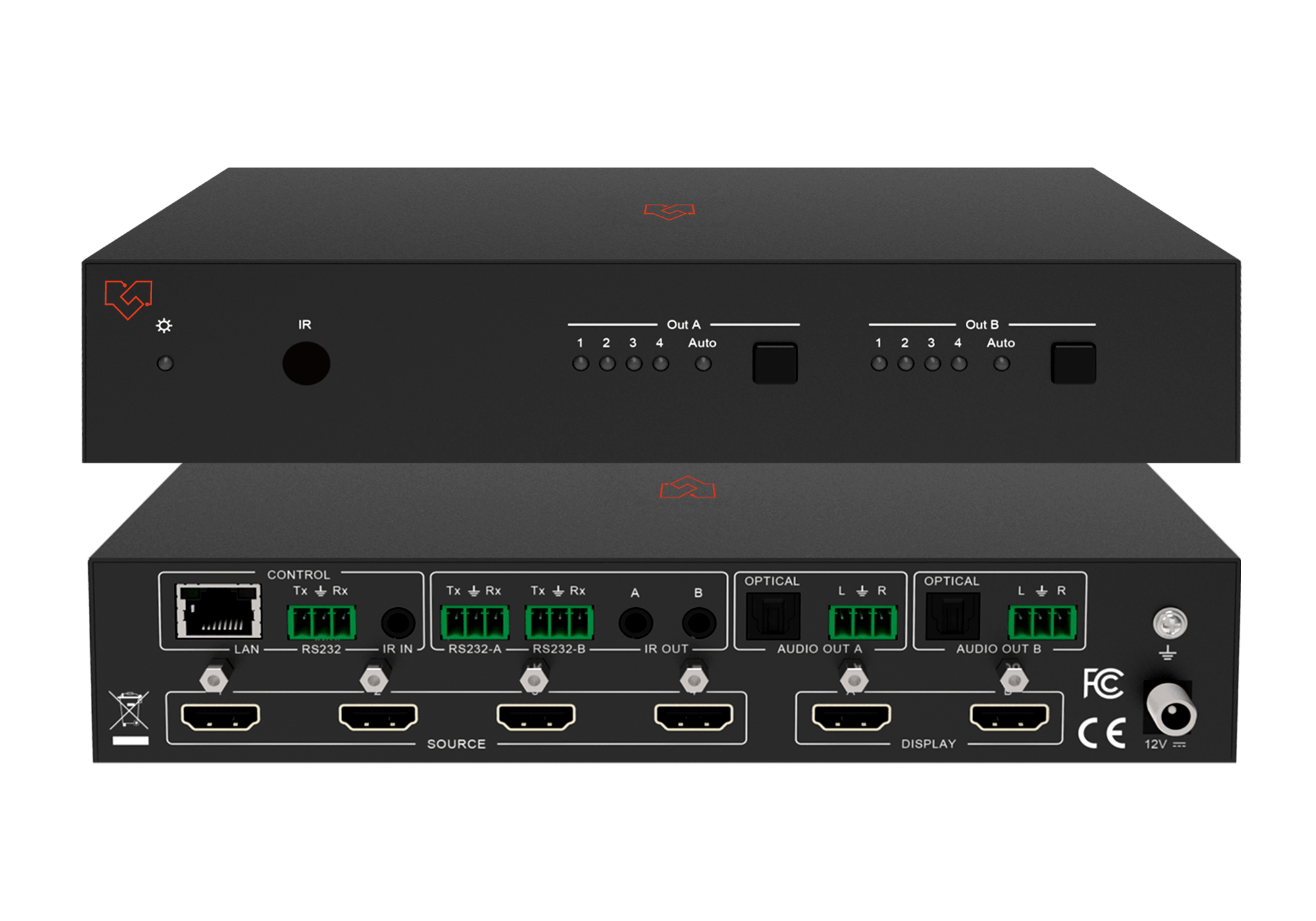
| VLMX-44CT70 | 4x4 | HDMI 2.0, 18Gbps, HDCP 2.2 | Integrated CAT extension to 70m | Mid-distance multi-room installs needing switching and extension without separate transmitters |
| VLMX-44HT2 | 4x4 | HDMI 2.0, 18Gbps, HDCP 2.2 | Integrated HDBaseT extension to 150m | Corporate campuses and hospitality properties needing long-distance 4-source routing |
| VLMX-88HT2 | 8x8 | HDMI 2.0, 18Gbps, HDCP 2.2 | Integrated HDBaseT extension to 150m | Large multi-room hospitality and auditorium installs needing long-distance 8-source routing |
| HDMI 2.0 — Downscaling | ||||
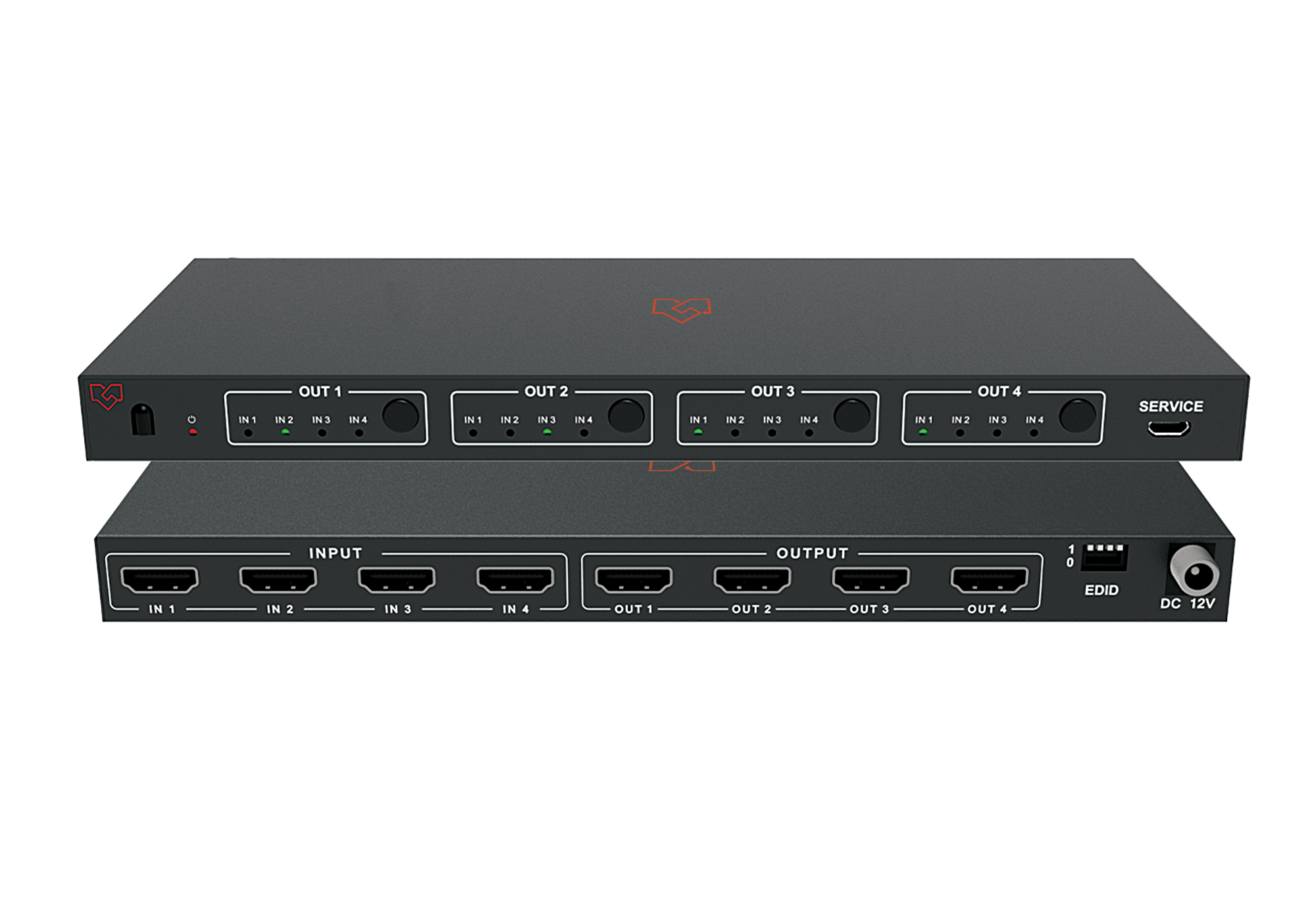
| VLMX-0404E | 4x4 | HDMI 2.0, 18Gbps, HDCP 2.2 | Per-output 4K-to-1080p downscaling, display control (RS-232/CEC) | Mixed-resolution installs needing automated display power management alongside downscaling |
| VLMX-0402E | 4x2 | HDMI 2.0, 18Gbps, HDCP 2.2 | Per-output 4K-to-1080p downscaling, display control (RS-232/CEC) | Smaller mixed-resolution installs needing automated display power management |
| VLMX-0404 | 4x4 | HDMI 2.0, 18Gbps, HDCP 2.2 | Per-output 4K-to-1080p downscaling only, no display control | Mixed-resolution installs needing downscaling without display power automation |
| VLMX-0402 | 4x2 | HDMI 2.0, 18Gbps, HDCP 2.2 | Per-output 4K-to-1080p downscaling only, no display control | Smaller mixed-resolution installs needing downscaling without display power automation |
6-Year WarrantyUp to 48GbpsFull-Bandwidth Every PortMulti-Protocol Control
Professional HDMI Matrix Switchers
VigilLink's HDMI Matrix Switcher range provides professional-grade, any-input-to-any-output routing for multi-source, multi-display AV systems, from 4K@60Hz HDMI 2.0 at 18Gbps through 8K@60Hz HDMI 2.1 at the full 48Gbps. Unlike a simple distribution amplifier, which sends one source to many displays, a matrix switcher allows any connected source to be routed independently to any connected display at any time, with each output assignable to a different input. This capability makes matrix switchers the central routing hub for conference centers, broadcast facilities, control rooms, hospitality environments, and any installation where multiple sources and multiple displays must operate flexibly and simultaneously.
The VLMX line spans four families. HDMI 2.1 models deliver 48Gbps bandwidth with 8K@60Hz, 4K@120Hz, HDCP 2.3, and built-in audio de-embedding on every output. HDMI 2.0 models deliver 4K@60Hz at 18Gbps with HDCP 2.2 in basic, HDBaseT-extended, and downscaling configurations. Every model in the line supports HDR passthrough and control via front panel, IR, RS-232, and TCP/IP, in consistent rack-mount form factors backed by VigilLink's 6-year warranty.
Why Choose VigilLink HDMI Matrix Switcher
8K HDMI 2.1 at the full 48Gbps — the VLMX-8K4x4AIR and VLMX-8K8x8AIR deliver 8K@60Hz 4:2:0, 8K@30Hz 4:4:4, and 4K@120Hz 4:4:4 with HDCP 2.3, HDR10+, Dolby Vision, and the complete VRR/ALLM/QMS/QFT/SBTM feature set on every output
Built-in audio de-embedding on every output — HDMI 2.1 models provide one optical S/PDIF and one balanced analog output per HDMI output, with independent audio matrix routing and ARC return audio, eliminating a separate de-embedder behind every display
Full bandwidth maintained on every output — no bandwidth sharing or degradation as port utilization increases, on any model in the line, at either 18Gbps or 48Gbps
Four technology families in one unified product line — 8K HDMI 2.1, basic HDMI 2.0, HDBaseT-extended, and downscaling models share consistent control architecture and rack form factors, allowing scalable system design within a single ecosystem
Integrated HDBaseT extension at 70m and 150m — HDBaseT matrix models eliminate separate transmitters and receivers for each output, reducing rack space, cabling cost, and installation complexity in large-venue and multi-room systems
Per-output downscaling for mixed-resolution installations — HDMI 2.0 downscaling models convert 4K to 1080p per output, while HDMI 2.1 models add 8K-to-4K and 8K/4K-to-1080p conversion plus per-output HDR-to-SDR, so a single matrix can drive 8K, 4K, and legacy 1080p displays simultaneously
Multi-protocol control on every model — front panel buttons, IR remote, RS-232, and TCP/IP control are standard across the VLMX line, enabling integration with third-party control systems including Crestron, AMX, Extron, and VigilLynx™
6-year warranty across the product line — VigilLink's industry-leading 6-year warranty covers every VLMX-series matrix switcher
Choosing the Right HDMI Matrix Switcher
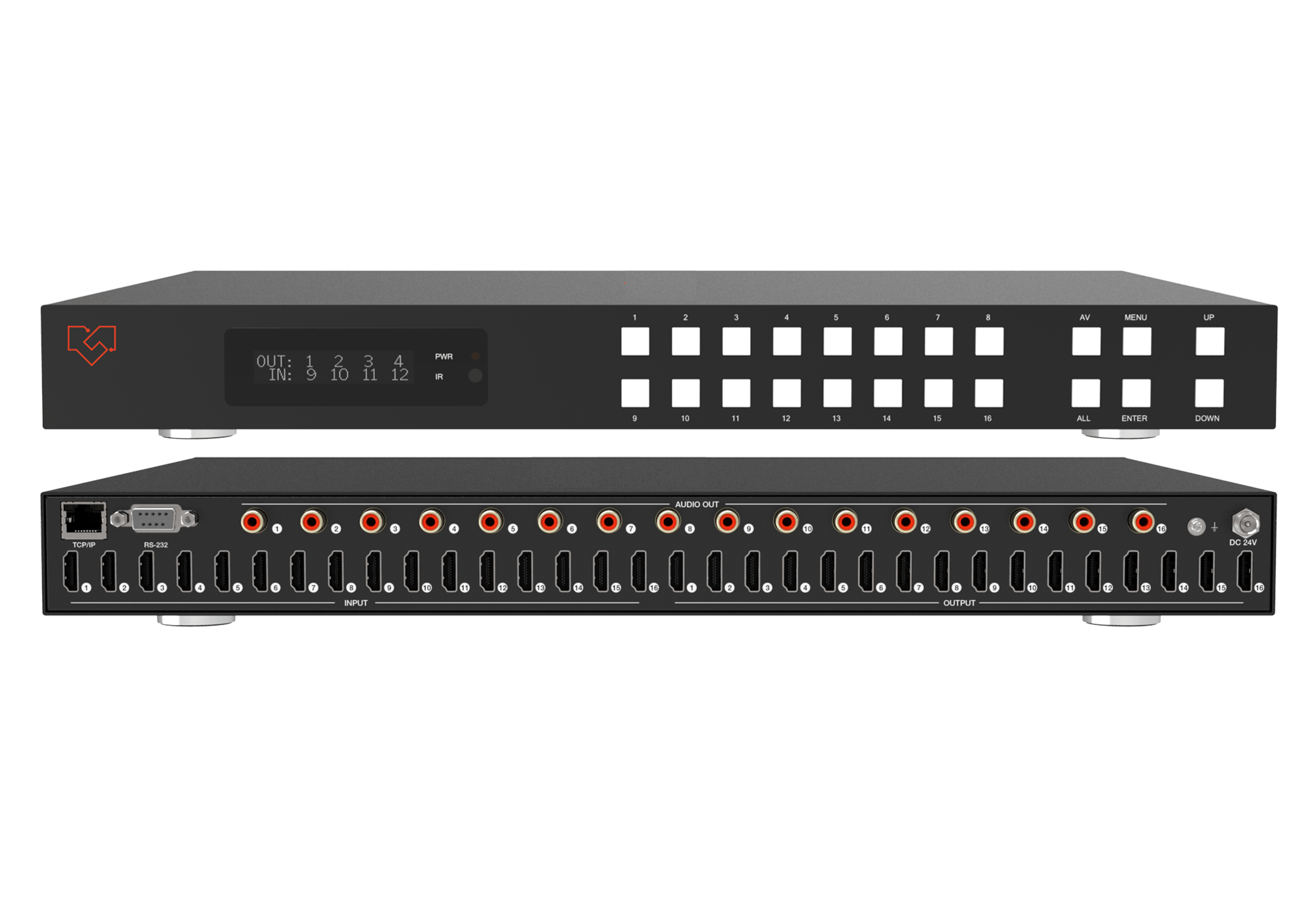
Basic HDMI Matrix (VLMX-0202E / VLMX-0808E / VLMX-1616E): HDMI 2.0 — pure 4K 18Gbps switching with HDMI outputs, for installations where displays are within standard HDMI cable distance of the matrix. Available in 2x2, 8x8, and 16x16 port configurations. Choose this family for control rooms, broadcast equipment racks, server room AV distribution, and any environment where the matrix and displays are co-located.
8K HDMI 2.1 with Audio De-Embedding (VLMX-8K4x4AIR / VLMX-8K8x8AIR): Full 48Gbps HDMI 2.1 switching with 8K@60Hz, 4K@120Hz 4:4:4, HDCP 2.3, and the complete gaming feature set, plus per-output audio de-embedding to optical S/PDIF and balanced analog. Available in 4x4 and 8x8 configurations, both in a 1U rack enclosure. Choose this family for 8K-ready installations, next-generation console and gaming environments, luxury home theater, and any system where each display needs its own independently routed audio zone.
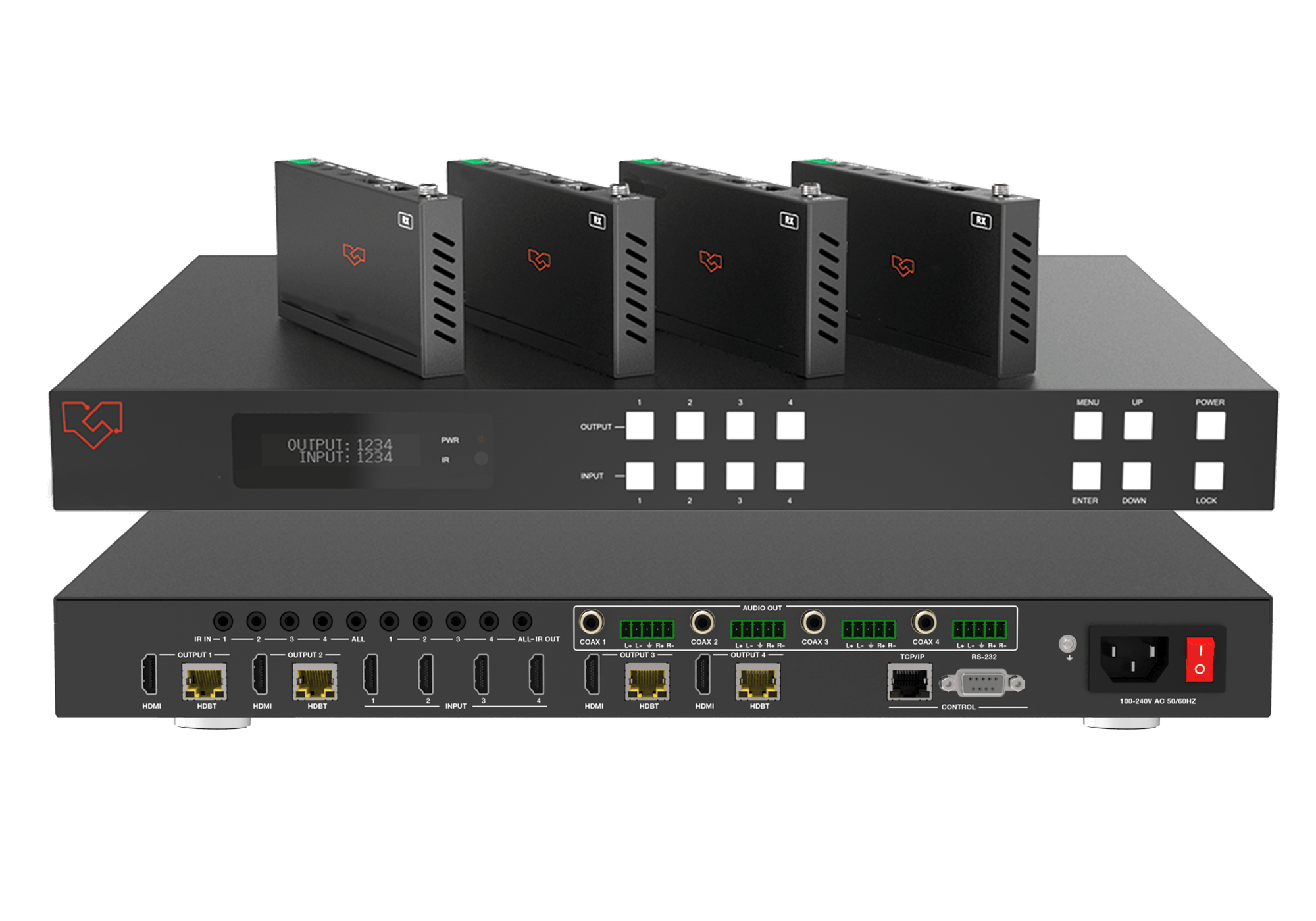
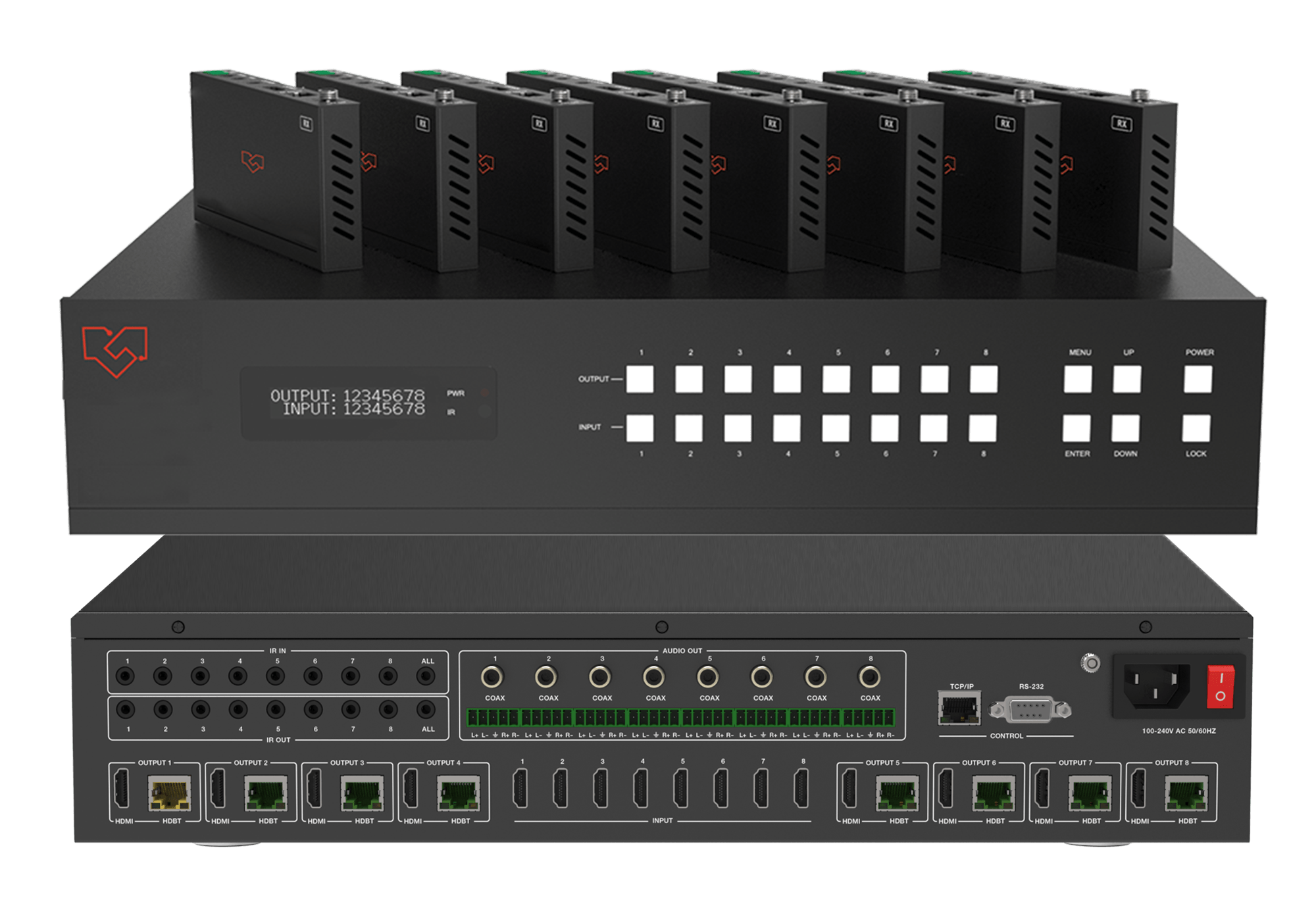
HDBaseT Extension Matrix (VLMX-44CT70 / VLMX-44HT2 / VLMX-88HT2): HDMI 2.0 — integrated 4K 18Gbps switching and long-distance extension over Cat6, eliminating separate HDBaseT transmitters and receivers. The VLMX-44CT70 delivers 4x4 switching with Cat extension to 70m; the VLMX-44HT2 and VLMX-88HT2 extend HDBaseT to 150m in 4x4 and 8x8 configurations respectively. Choose for corporate campuses, hospitality properties, auditoriums, and any multi-room installation where displays are distributed across significant distances.
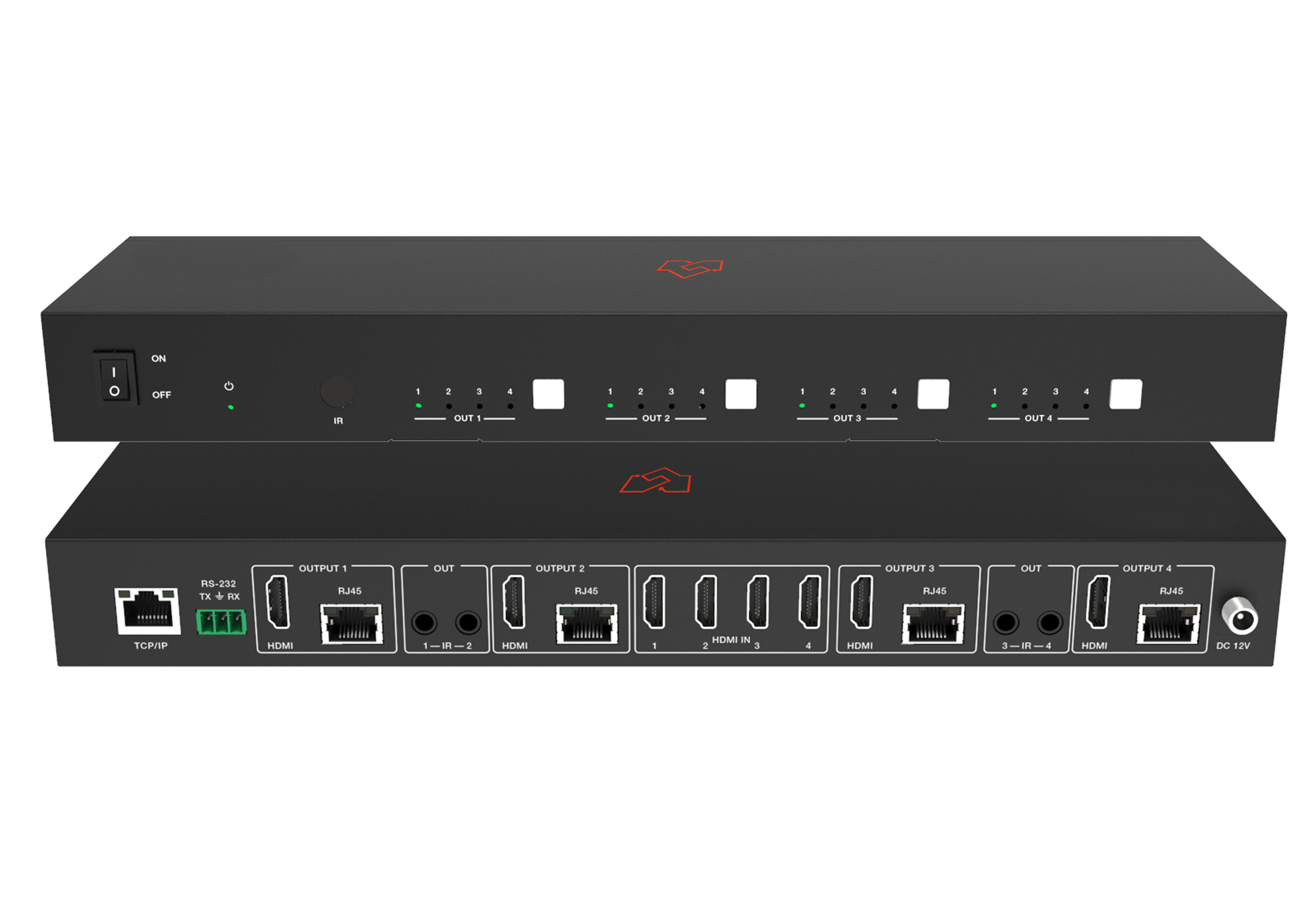
Downscaling Matrix (VLMX-0402 / VLMX-0404 / VLMX-0402E / VLMX-0404E): HDMI 2.0 — 4K 18Gbps switching with per-output 4K-to-1080p downscaling on every output, available in 4x2 and 4x4 port configurations. E-suffix models add display control (RS-232/CEC) for automated display power management. Choose when the installation includes a mix of 4K and legacy 1080p displays, or when display power control from the matrix is required.
Key Selection Variable: Bandwidth first, then distance. If any source is 8K or 4K@120Hz, or if any output requires de-embedded audio, choose the HDMI 2.1 family. If all sources are 4K@60Hz or below, select the HDMI 2.0 family — HDBaseT if displays are beyond HDMI cable reach, downscaling if the display fleet is mixed-resolution, basic if displays are co-located with the rack.
Ideal Applications
Corporate Conference Centers & Multi-Room AV
Multi-room conference centers require any-source-to-any-room routing that changes throughout the day. An 8x8 or 16x16 basic matrix (VLMX-0808E, VLMX-1616E) routes laptop, video conferencing, and presentation sources to any combination of conference room displays from a central AV rack. TCP/IP and RS-232 control integration connects the matrix to room scheduling and AV control systems for automated source switching based on meeting bookings.
Hospitality & Large Venue Distribution
Hotels, arenas, and convention centers require 4K content distribution to displays positioned throughout large properties — well beyond standard HDMI cable reach. HDBaseT extension matrix models (VLMX-44HT2, VLMX-88HT2) route and extend switched 4K signals to 150m over existing Cat6 infrastructure, eliminating separate transmitter/receiver pairs at every display location and dramatically reducing installation materials and labor.
Broadcast Control Rooms & Production Facilities
Control rooms require rapid, reliable source switching between cameras, playback systems, graphics, and external feeds across multiple monitoring positions. The VLMX-1616E's 16x16 capacity and TCP/IP control enable integration with broadcast control systems for operator-driven routing. Consistent 4K 18Gbps bandwidth across all outputs ensures monitoring displays receive identical full-bandwidth signals regardless of routing state.
Mixed-Resolution Display Environments
Facilities undergoing display fleet upgrades often operate 8K, 4K, and 1080p displays simultaneously across the same AV infrastructure. HDMI 2.0 downscaling models (VLMX-0404, VLMX-0404E) route 4K sources to all outputs while automatically downscaling to 1080p for legacy displays, with the VLMX-0404E adding display control to automate power management across the fleet. For installations that have begun adopting 8K, the VLMX-8K4x4AIR and VLMX-8K8x8AIR extend this to three tiers — routing 8K natively, downscaling to 4K, or downscaling to 1080p on a per-output basis, with independent HDR-to-SDR conversion for displays that cannot process HDR metadata.
Education & Training Environments
Universities and corporate training facilities require flexible routing of instructor workstations, media playback, and distance learning feeds to multiple classroom displays. An HDBaseT matrix (VLMX-44HT2) routes four independent sources to four classrooms over existing Cat6 infrastructure, with each room receiving its own independently selected source. RS-232 and TCP/IP control enables integration with campus AV control systems for simplified operation by non-technical staff.
Luxury Home Theater & High-Performance Gaming
High-end residential and esports installations require 4K@120Hz and 8K routing with VRR and ALLM preserved end-to-end, plus audio extracted to a reference AV processor. The VLMX-8K4x4AIR and VLMX-8K8x8AIR pass the full HDMI 2.1 gaming feature set with zero-latency switching, while de-embedding audio to optical S/PDIF for the theater processor and balanced analog for distributed-audio zones elsewhere in the property. ARC support returns audio originating on a smart display back into the matrix for routing into the house audio system.
Frequently Asked Questions
What is an HDMI matrix switcher?
An HDMI matrix switcher is a professional AV device that routes any HDMI input independently to any HDMI output. Unlike a distribution amplifier — which sends one input to all outputs — a matrix switcher allows each output to display a different source simultaneously. For example, a 4x4 matrix can send Input 1 to Output 3, Input 2 to Outputs 1 and 4, and Input 3 to Output 2, all at the same time. This flexibility makes matrix switchers essential for multi-room AV systems, control rooms, and any environment with multiple sources and multiple independent display destinations.
Which VigilLink matrix switchers have audio de-embedding?
The VLMX-8K4x4AIR and VLMX-8K8x8AIR include audio de-embedding on every output. Each HDMI output has a matching optical S/PDIF output (LPCM 2.0CH, Dolby/DTS 5.1CH) and a matching balanced analog output on a 5-pin 3.81mm Phoenix connector (LPCM 2CH). The de-embedded audio can be bound to inputs, bound to outputs, or routed as a fully independent audio matrix — including ARC return audio from any connected display. This replaces four external de-embedders on the 4x4 model and eight on the 8x8.
Should I choose an HDMI 2.1 or HDMI 2.0 matrix switcher?
Choose HDMI 2.1 (VLMX-8K4x4AIR, VLMX-8K8x8AIR) if any source in the system outputs 8K, 4K@120Hz, or requires VRR and ALLM — a next-generation games console, a high-refresh gaming PC, or an 8K camera or media server. Also choose HDMI 2.1 if any output needs de-embedded audio. Choose HDMI 2.0 if every source is 4K@60Hz or below, which covers most corporate, education, hospitality, and digital signage installations. An HDMI 2.0 matrix will accept an HDMI 2.1 source but caps every output at 4K@60Hz and disables VRR, ALLM, and high-frame-rate features.
What bandwidth do VigilLink matrix switchers support?
VigilLink matrix switchers are available in two bandwidth tiers. HDMI 2.1 models (VLMX-8K4x4AIR, VLMX-8K8x8AIR) operate at the full 48Gbps, carrying 8K@60Hz 4:2:0, 8K@30Hz 4:4:4, and 4K@120Hz 4:4:4 with HDCP 2.3. HDMI 2.0 models operate at 18Gbps, carrying 4K@60Hz at full 4:4:4 chroma with HDR metadata and HDCP 2.2. In both tiers, the rated bandwidth is maintained on every input and every output simultaneously, without bandwidth sharing or reduction as port utilization increases.
How does an HDBaseT matrix switcher differ from a basic HDMI matrix?
A basic HDMI matrix switcher has standard HDMI outputs and requires a separate HDMI cable — limited to approximately 10–15 meters — from each output to each display. An HDBaseT matrix switcher integrates long-distance extension directly into each output port, transmitting switched 4K signals over Cat6 cable to distances of 70m (VLMX-44CT70) or 150m (VLMX-44HT2, VLMX-88HT2) per output. HDBaseT matrix models eliminate the need for separate transmitters at the matrix and receivers at each display, simplifying multi-room system design significantly.
What is downscaling in an HDMI matrix switcher and why is it useful?
Downscaling means each output port can automatically convert a higher-resolution input to a lower resolution before sending it to the connected display. VigilLink's HDMI 2.0 downscaling models (VLMX-0402, VLMX-0404, VLMX-0402E, VLMX-0404E) convert 4K to 1080p per output. The HDMI 2.1 models (VLMX-8K4x4AIR, VLMX-8K8x8AIR) extend this with 8K-to-4K and 8K/4K-to-1080p conversion plus per-output HDR-to-SDR. A single matrix can therefore drive 8K, 4K, and legacy 1080p displays from the same source without a separate scaler at each display.
What control options do VigilLink matrix switchers support?
All VigilLink VLMX-series matrix switchers support multiple control interfaces: front panel buttons for manual switching, IR remote control, RS-232 serial control for third-party control systems (Crestron, AMX, Extron), and TCP/IP Ethernet control for network-based automation. This multi-protocol control architecture ensures compatibility with virtually any professional AV control system used in corporate, hospitality, broadcast, and institutional environments.
Can I send the same source to multiple outputs simultaneously?
Yes. VigilLink matrix switchers support routing a single input to multiple outputs simultaneously — this is standard matrix switching behavior. For example, on the VLMX-0808E, Input 1 can be routed to all eight outputs at once, or to any combination of outputs while other inputs are routed to the remaining outputs independently. This combines the any-to-any flexibility of matrix switching with the broadcast distribution of a splitter.
What HDMI content protection standards do VigilLink matrix switchers support?
HDMI 2.1 models (VLMX-8K4x4AIR, VLMX-8K8x8AIR) support HDCP 2.3, which is required for protected 8K and 4K@120Hz content. HDMI 2.0 models support HDCP 2.2, required for 4K UHD protected content from Blu-ray players, streaming devices, and cable or satellite receivers. Both HDCP 2.3 and HDCP 2.2 are backward compatible with HDCP 1.4, so any VLMX matrix passes protected 4K and legacy 1080p content without compatibility issues. HDR passthrough is supported across the entire line, with HDR10+, Dolby Vision, and HLG on the HDMI 2.1 models.
How do I choose between a 4x4, 8x8, and 16x16 matrix switcher?
Select the matrix size based on your maximum simultaneous source and display count, with headroom for future expansion. Count the total number of independent signal sources (computers, media players, cameras, conferencing systems) and the total number of independent display destinations. Choose the matrix size that accommodates both counts — a system with 6 sources and 7 displays requires at minimum an 8x8 matrix. For large facilities expecting growth, sizing up to the next port tier (e.g., 16x16 vs. 8x8) during initial installation is significantly less expensive than replacing the matrix later.