

Audio Amplifiers & Processors | Class D, DSP, Dante® Network Audio

Professional Audio Amplification Solutions
VigilLink's Audio Amplifiers & Processors range covers compact Class D power amplifiers engineered for professional installed sound — combining efficient amplification with integrated DSP processing and Dante® network audio connectivity in a single rackmountable unit. Current models span 30W to 150W output and are designed to serve as the final active stage in a distributed audio system, accepting both Dante network streams and local analog mic/line sources simultaneously.
Whether you need a compact single-zone amplifier for background music in a small retail space, a mid-power unit for conference room reinforcement, or a high-output amplifier driving multiple ceiling speakers across a large venue, VigilLink provides professional-grade hardware purpose-built for system integrators who need reliable, configurable, and network-ready amplification across every installation scale.
Why Choose VigilLink Audio Amplifiers
Class D high-efficiency amplification — delivers rated output power with minimal heat generation and low power consumption compared to Class A/B designs, enabling installation in standard equipment racks without forced cooling or oversized thermal management
Integrated DSP processing — built-in equalization, gain staging, and signal processing on select models eliminates the need for external DSP hardware in most single-zone or small multi-zone installations, reducing rack space and system cost
Dante® network audio connectivity — models with Dante® receive high-quality, low-latency digital audio directly from any Dante-compatible source on the network, enabling zone-level audio distribution without analog infrastructure runs between equipment racks and amplifier locations
Hybrid analog/network input architecture — every model accepts both Dante network streams and local analog inputs (mic/line), providing installation flexibility and ensuring local override capability for paging and emergency audio scenarios
PoE+ power on select models — network-powered operation eliminates dedicated power circuits at the amplifier location, simplifying installation in retrofit projects, above-ceiling closets, and remote zones where adding electrical is costly
Compact rackmount form factor — half-rack and 1U chassis designs integrate cleanly into AV equipment racks, server closets, and AV furniture without dedicating full rack units to amplification in space-constrained installations
Choosing the Right Audio Amplifier
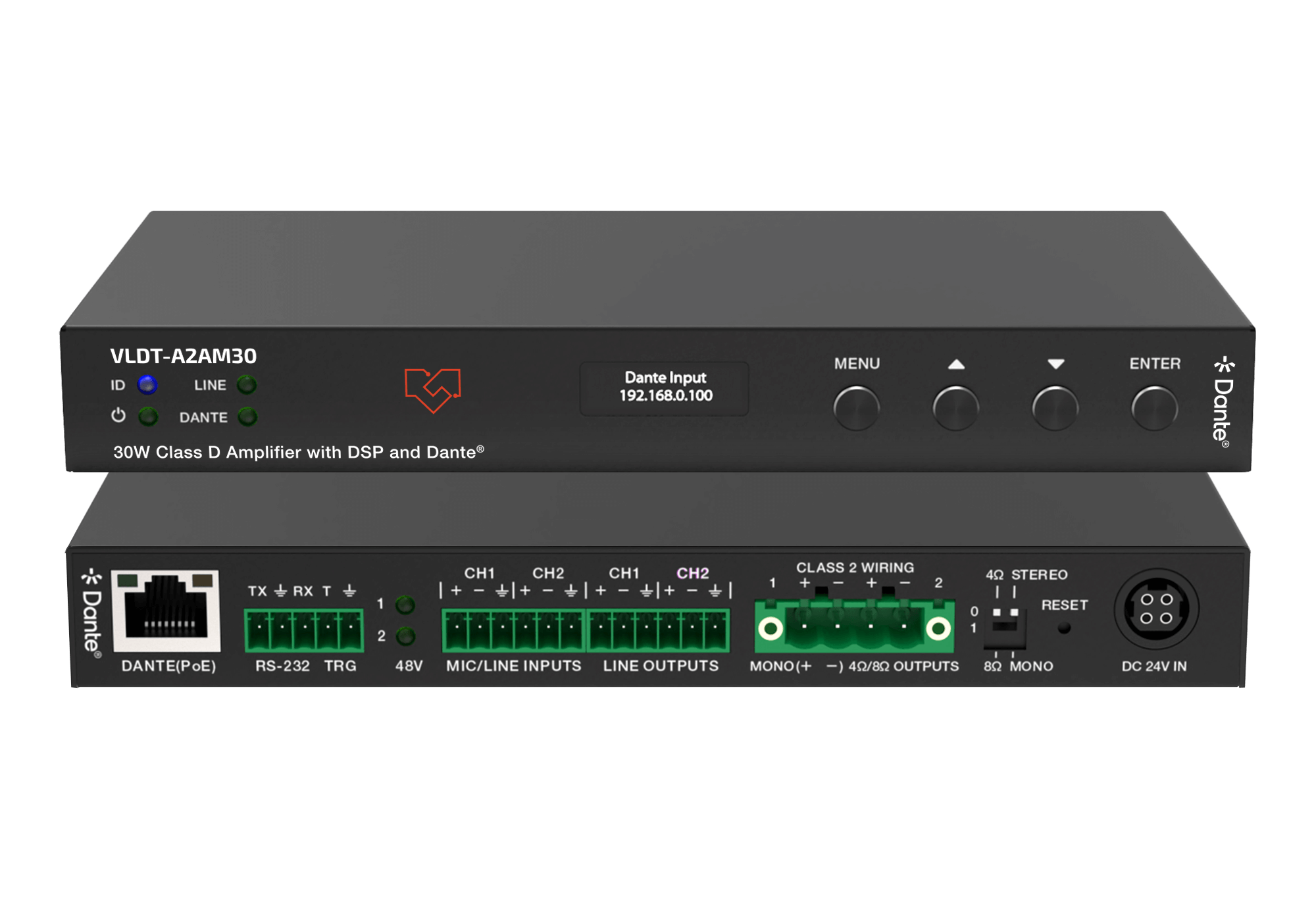
30W Dante® Amplifiers (VLDT-A2AM30): Optimized for small single-zone applications where moderate acoustic output is sufficient and Dante network audio connectivity is required. The VLDT-A2AM30 suits retail boutiques, small conference rooms, reception areas, waiting rooms, and residential or light commercial installations where ceiling speaker counts are low and ambient noise levels are manageable. Choose this tier when SPL requirements are modest and installation simplicity is the primary design goal.
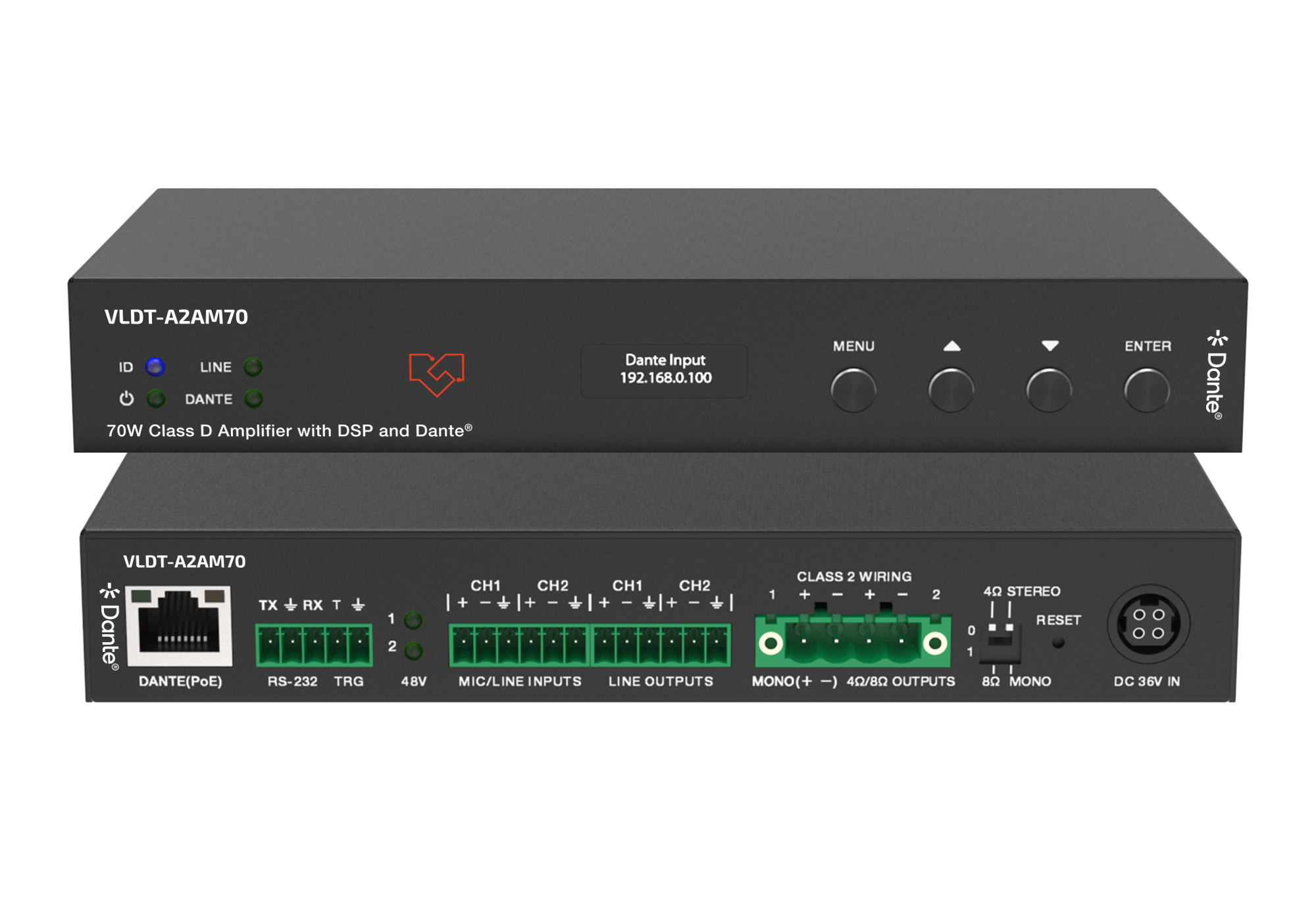
70W Dante® Amplifiers (VLDT-A2AM70): Suitable for medium-sized spaces requiring higher output and greater headroom for music and speech reinforcement. The VLDT-A2AM70 handles restaurants, fitness studios, larger conference rooms, commercial lobbies, and applications where audio intelligibility across a larger coverage area demands additional power. Choose this tier when a single amplifier must drive four or more ceiling speakers, or when the acoustic environment introduces significant background noise requiring greater gain margin.
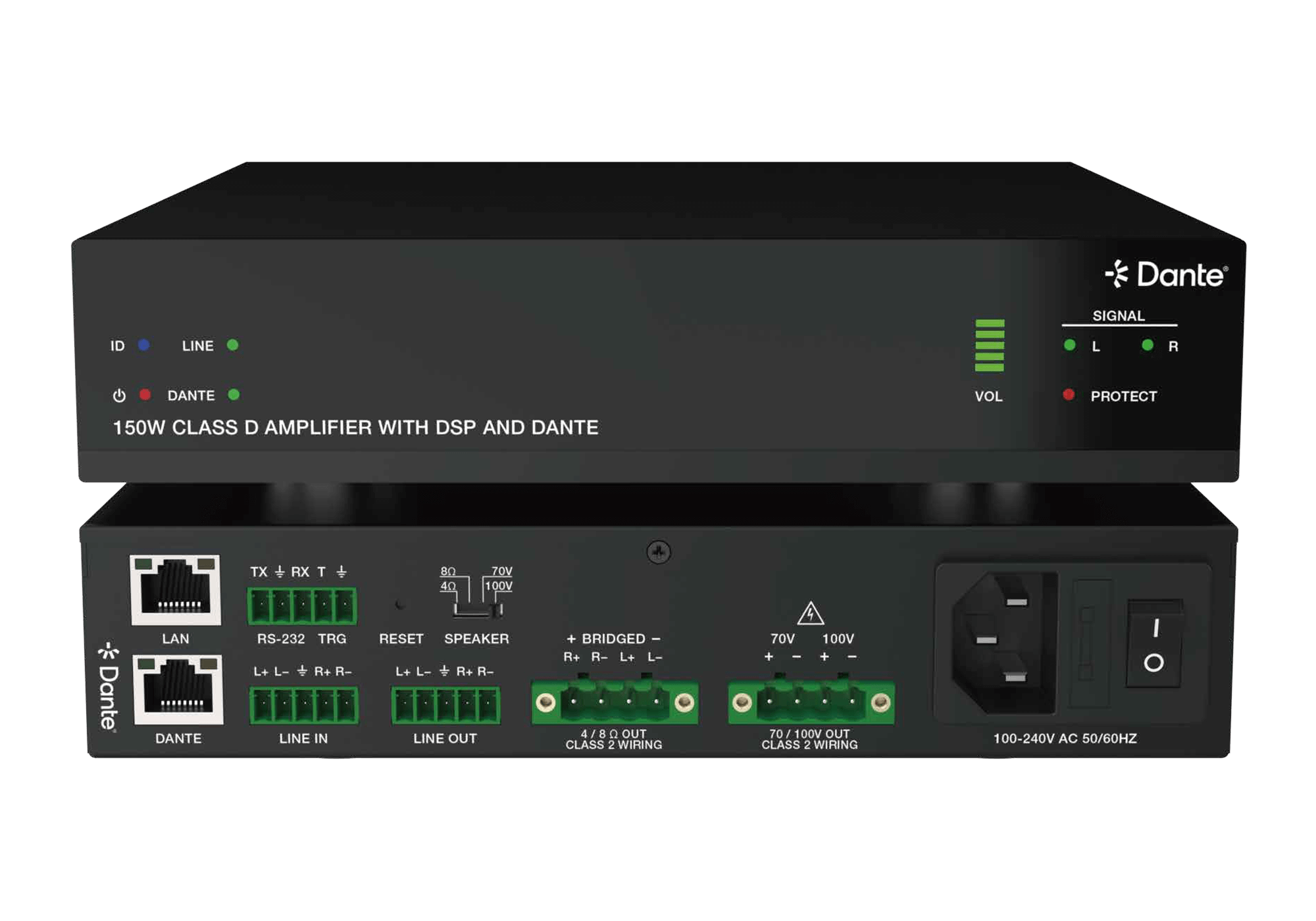
150W Dante® Amplifiers (VLDT-A2AM150): Designed for demanding applications requiring substantial acoustic output across large coverage areas or challenging speaker loads. The VLDT-A2AM150 powers gymnasiums, warehouses, multi-purpose halls, outdoor paging zones, and any installation with low-sensitivity speakers, long cable runs, or multiple parallel speaker loads per zone. DSP processing on the 150W model provides advanced equalization and level control for complex system tuning requirements.
Power Tier Selection: Calculate required output power based on speaker sensitivity (dB/1W/1m), desired zone SPL, room volume, and acoustic treatment. As a general rule, doubling amplifier power adds approximately 3dB of headroom — size up when headroom for announcements, emergency override, or high-ambient-noise environments is required. For multi-zone installations, individual zone amplifiers offer simpler zoning and independent DSP control compared to multi-channel chassis amplifiers.
Ideal Applications
Corporate Campus & Enterprise Facilities
VigilLink Dante® amplifiers distribute background music, paging, and scheduled announcements across multi-room corporate campuses from a centralized Dante network infrastructure. Individual zone amplifiers in server closets or above-ceiling enclosures receive audio from a Dante-enabled source without analog cable runs between the equipment room and each zone. Integrated DSP handles per-zone equalization, compensating for acoustic differences between carpeted offices, glass-walled conference rooms, and hard-surface lobbies from a single centralized configuration.
Retail & Hospitality
Background music and in-store messaging systems for retail chains, hotels, and restaurants benefit from the Dante amplifier's ability to receive centralized content from a managed Dante network while accepting local override audio via analog inputs. PoE+ models on select units eliminate the need for dedicated power circuits in leased retail spaces where electrical modifications are restricted, simplifying both initial installation and future tenant changeouts. Each zone amplifier provides independent volume and EQ control for tailored customer audio experiences.
Educational Institutions
Schools, universities, and training centers use VigilLink amplifiers to power classroom sound reinforcement, campus-wide paging, and assembly space audio from a unified network audio infrastructure. Dante® connectivity allows AV administrators to route program audio, scheduled bell systems, or emergency announcements to any zone from a central console without visiting individual amplifier locations. The 150W model handles gymnasium and large assembly spaces where ceiling height and room volume demand higher output and more aggressive DSP correction.
House of Worship
Multi-zone audio in sanctuary, fellowship hall, lobby, and overflow spaces benefits from Dante-networked amplifiers that receive a common mix from the main audio system while providing independent level control per zone. Local analog inputs on every model allow a direct backup source — such as a portable mixer or announcement microphone — to drive any zone independently of the network, meeting both routine programming and emergency audio requirements without a secondary analog distribution system.
Fitness & Recreation
Gyms, aquatic centers, group fitness studios, and recreation facilities operate audio zones with different content, volume levels, and acoustic demands simultaneously. The 70W and 150W VigilLink amplifiers handle demanding environments with high ambient noise, challenging room geometries, and speaker loads distributed across wet or outdoor zones. Class D efficiency and thermal protection circuits ensure reliable continuous operation in facilities that run amplification systems for twelve or more hours per day.
Frequently Asked Questions
What is a Dante® network audio amplifier and how does it differ from a conventional amplifier?
A Dante® network audio amplifier combines a standard power amplifier with a Dante-enabled digital audio receiver, allowing it to accept audio directly from any Dante-compatible source on a standard IP network without analog cable runs from a central amplifier rack to each zone. Conventional amplifiers require dedicated analog audio cabling between the signal source and the amplifier; Dante amplifiers replace that cabling with a standard CAT5e/6 Ethernet connection that simultaneously carries the audio signal, network control data, and — on PoE+ models — power. The amplifier then converts the received digital audio stream to speaker-level output for connected loudspeakers.
What wattage amplifier do I need for my installation?
Amplifier power selection depends on speaker sensitivity (measured in dB/1W/1m), desired SPL at the listening position, room volume, and acoustic conditions. As a general guideline: 30W suits small zones with 90dB+ sensitivity ceiling speakers in quiet environments; 70W handles medium spaces or speakers with lower sensitivity ratings; 150W is appropriate for large rooms, low-sensitivity speakers, long cable runs, or installations requiring significant headroom for paging and emergency announcements above high ambient noise. Always size for the worst-case operating condition in the zone rather than average use.
Can VigilLink audio amplifiers accept analog inputs in addition to Dante network audio?
Yes. All VigilLink Dante® audio amplifiers include local analog mic/line inputs alongside Dante network audio inputs. This hybrid input architecture allows the amplifier to receive primary audio from the Dante network while accepting local override from a microphone, analog source, or paging station connected directly to the amplifier. Input priority and mixing behavior are configurable via the onboard controls or DSP software on supported models.
What is Class D amplification and why is it preferred for installed audio?
Class D is a switching amplifier topology that achieves efficiency ratings of 85–95%, compared to 50–70% for traditional Class A/B designs. In installed AV applications, this efficiency advantage means significantly less heat is generated per watt of output power, allowing amplifiers to be installed in standard equipment racks without forced-air cooling or thermal derating. Lower heat generation also improves long-term component reliability in environments where equipment runs continuously. VigilLink Class D amplifiers deliver the same audio quality as Class A/B designs while consuming less power and generating less heat.
Do VigilLink amplifiers include built-in DSP?
Yes, on select models. The VLDT-A2AM150 includes integrated DSP processing with equalization, gain control, and signal management configurable via software. The 30W and 70W models include basic level control. Integrated DSP eliminates the need for a separate DSP processor in single-zone applications and reduces rack space and cost in multi-zone systems where each zone amplifier handles its own signal processing independently.
What is PoE+ and which VigilLink amplifiers support it?
PoE+ (Power over Ethernet Plus, IEEE 802.3at) delivers up to 30W of DC power to a device over the same CAT5e/6 Ethernet cable used for data. VigilLink amplifiers with PoE+ support can be powered entirely from a PoE+ switch or injector, eliminating the need for a dedicated AC power circuit at the amplifier location. This is particularly valuable in retrofit installations, above-ceiling equipment closets, and remote zones where adding electrical circuits is expensive or impractical. Check individual model specifications for PoE+ availability.
What is the difference between the VLDT-A2AM30, VLDT-A2AM70, and VLDT-A2AM150?
The three models differ primarily in output power and DSP capability. The VLDT-A2AM30 delivers 30W Class D output for small zones and light commercial applications. The VLDT-A2AM70 provides 70W for medium spaces and higher-output requirements. The VLDT-A2AM150 delivers 150W with full integrated DSP for demanding applications requiring significant acoustic output and advanced signal processing. All three models share the same Dante® network audio connectivity and analog mic/line input architecture.
Can VigilLink audio amplifiers be used without Dante® — with analog-only sources?
Yes. All VigilLink Dante® amplifiers accept analog mic/line input independently of the Dante network. An amplifier can operate in a fully analog signal chain using only the local input, making it functional in installations that have not yet deployed Dante network infrastructure or in temporary configurations where Dante is unavailable. When Dante becomes available, the same amplifier integrates into the network without hardware changes.