Home > Dante® Network Audio> Audio Amplifiers > VLDT-A2AM30


30W Class D Audio Amplifier with Dante® and Line/Mic Inputs
VLDT-A2AM30
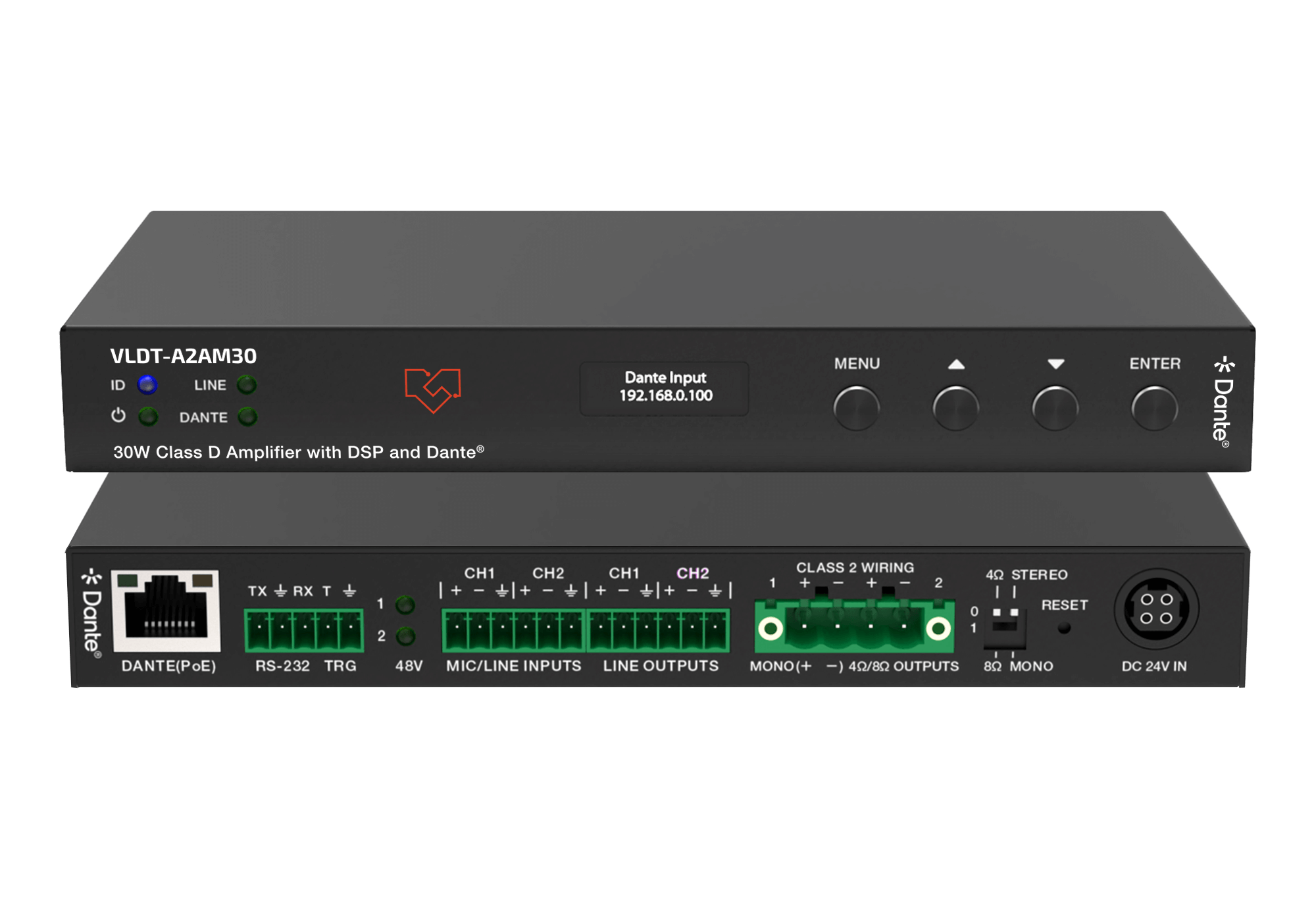
Advanced 30W (2x 15W) Class-D audio amplifier with Dante® integration
Supports microphone input with 48V phantom power
Integrated audio DSP processing includes gain, ducking, mixing, matrixing, equalizer, volume and delay control
Flexible control via front panel buttons, RS-232, TCP/IP and Web GUI
Product Description
The VLDT-A2AM30 is a two-channel Class D amplifier designed for compact audio distribution systems. It delivers up to 2× 15W into low-impedance (4Ω/8Ω) stereo loads, or 1× 30W in bridged mono mode. The amplifier features Dante® 2-channel digital inputs and outputs, plus 2-channel balanced or unbalanced analog inputs and outputs for comprehensive connectivity. Analog inputs accommodate both microphone and line-level signals, with 48V phantom power available for condenser microphones.
Integrated DSP provides extensive audio processing including gain control, mixing, matrixing, equalization, volume adjustment, and delay. Control options include RS-232, TCP/IP, and an integrated web GUI interface for flexible system management.
This versatile amplifier is well-suited for professional AV installations in corporate boardrooms, huddle spaces, retail and hospitality venues, and distributed audio systems. It seamlessly integrates legacy analog sources with Dante-enabled infrastructure, powering ceiling speakers, zone speakers, and monitor systems while simplifying installation in both new builds and retrofit applications.
Dante® (Digital Audio Networking Through Ethernet) is a media networking technology developed by Audinate that transports high-quality, low-latency audio over standard IP networks using off-the-shelf Ethernet switches and Cat5e/6 cabling. Unlike traditional point-to-point analog or digital audio connections, Dante® allows hundreds of audio channels to be routed across a single network, with any device on the network able to send or receive audio from any other device — configured entirely in software. The VLDT-A2AM30 implements Dante® connectivity, enabling it to receive audio from any Dante® source on the network and integrate seamlessly with the thousands of Dante®-enabled products from over 600 manufacturers worldwide.
Key Features
Integrates Dante® networked audio with local analog sources and amplified speaker outputs for flexible zone control
Professional >100dB dynamic range and <0.01% THD+N with 30W Class D amplification for clear, distortion-free audio reproduction
Advanced 30W (2x 15W) Class-D audio amplifier with Dante® integration
2x 15W@4/8ohm, 1x 30W@4/8ohm
Dante® 2x2 and AES67 audio input/output supported
Balanced/unbalanced analog input and output for cascading connection
Dante® 2CH digital audio, balanced or unbalanced line level analog and AMP outputs
Supports microphone input with 48V phantom power
Audio DSP processing includes gain, ducking, mixing, matrixing, equalizer, volume and delay control
Audio output supports 8 band PEQ adjustment (with +15dB/-15dB gain), and a maximum of 50ms delay setting
Local 5-12V input trigger for disabling amplifier output
Auto standby mode (0~100 minutes can be set) with signal sensing
Integrated web page function, which can control the local machine and query the working status of the product through the web page
Supports network control function, slave devices in the same network segment can be controlled through the set host
Dante audio support: 44.1kHz, 48kHz, 88.2kHz, and 96kHz sampling rates @ 16/24bit
Dante audio delay supports settings of 2, 3, 4, 5 or 10ms
Flexible control via front panel buttons, RS-232, TCP/IP and Web GUI
Power via PoE or local DC power supply (Amplifier power limited when using PoE)
Downloads
Ideal Applications
Corporate Boardrooms and Conference Rooms
Perfect for corporate meeting spaces where professional audio quality and seamless AV integration are critical. The VLDT-A2AM30's Dante networking capability enables easy integration with modern conferencing systems, while the balanced mic inputs with 48V phantom power support high-quality condenser microphones for clear speech reproduction. DSP processing with ducking automatically reduces background music when microphones are active, and the web GUI enables remote management from IT infrastructure. Connect conference table microphones to balanced inputs, link to Dante network for distribution to recording systems and remote participants, and use the trigger input to disable amplifier output during video conferences to prevent acoustic feedback. PoE power option eliminates need for separate power outlets, streamlining rack installations and simplifying deployment in modern meeting spaces.
Retail Store Background Music and Paging Systems
Designed for retail environments requiring reliable background music distribution with voice paging priority. The VLDT-A2AM30's mixing and ducking capabilities make it ideal for retail audio systems that need to seamlessly blend music with priority announcements while maintaining consistent audio quality across the space. Audio mixing allows simultaneous music and paging with automatic ducking for clear announcements, while network control enables centralized management of multiple zones from a single interface. Route background music through Dante input, connect paging microphone to mic input with phantom power, and configure DSP ducking to reduce music by 15dB during announcements. Cascading analog outputs support multi-room expansion without additional network infrastructure, and auto standby mode reduces power consumption during non-business hours, making it cost-effective for 24/7 retail operations.
Hospitality and Restaurant Audio Zones
Ideal for hotels, restaurants, and hospitality venues needing flexible audio distribution with zone control and the ability to accommodate both background ambiance and live performance audio. The VLDT-A2AM30 provides the versatility to handle diverse audio sources while maintaining professional sound quality across different venue zones. Dual analog and Dante inputs accommodate both legacy audio systems and modern network infrastructure, while matrix routing enables flexible source-to-zone assignments for different areas of the venue. Connect music sources via Dante, use mic inputs for live performances or DJ setups, and configure matrix routing for bar area versus dining area audio. Individual channel delay compensation synchronizes audio across distributed speaker systems, and RS-232 control integrates with existing building automation. The 30W output power is ideal for small to medium zones with 70V or 8Ω distributed speakers throughout the venue.
Huddle Spaces and Small Meeting Rooms
Essential for modern offices adopting huddle spaces that require simplified AV systems with professional capabilities. The VLDT-A2AM30's compact form factor, PoE power option, and comprehensive control interfaces make it perfect for quick-deploy meeting spaces that need enterprise-grade audio without complex infrastructure. Single Ethernet cable provides both network audio and power via PoE, minimizing installation complexity in tight spaces. Web interface enables IT staff to configure and troubleshoot remotely without site visits, while Dante compatibility integrates seamlessly with UC platforms like Microsoft Teams Rooms and Zoom. Deploy on existing network infrastructure with PoE switch, connect ceiling speakers for program audio, integrate with UC codec via Dante for consistent audio quality, and use web GUI to set EQ profiles optimized for speech intelligibility. The compact size fits behind displays or under tables without requiring dedicated rack space, ideal for distributed meeting room deployments.
Educational Institutions and Training Facilities
Perfect for classrooms, training centers, and educational facilities requiring audio systems that support both instructor microphones and multimedia content. The VLDT-A2AM30 offers the flexibility to handle diverse source types while providing the DSP processing needed to ensure clear speech reproduction in acoustically challenging spaces. The 48V phantom power supports professional wireless mic receivers and direct condenser mic connections, while gain control and mixing ensure balanced levels between instructor voice and multimedia playback. Connect instructor wireless mic receiver to balanced mic input, route multimedia from PC or AV system via Dante or analog input, and configure ducking to automatically reduce multimedia volume when instructor speaks. Network control allows IT departments to standardize configurations across multiple classrooms, while auto standby reduces energy consumption in line with sustainability initiatives. Use 8-band EQ to compensate for room acoustics and ensure clear speech in reflective classroom environments.
Specifications
| Technical | |
| Network Bandwidth | 100M |
| Audio Latency | • Configurable Dante® device latency: (Supports 2, 3, 4, 5 or 10ms configurable using Dante Controller) • Configurable AMP/analogue output latency: (0~50ms) |
| Output Power | 2x15W@4/8ohm Stereo, 1x30W@4/8ohm Mono |
| Amplifier Type | Class D |
| Audio Format | • Dante® [Dante/AES67 digital audio in/out, PCM 2CH 44.1K-96kHz 16/24Bit] • LINE IN [Analog audio, Balanced/unbalanced, Max input level 24dBu] • MIC IN [Analog audio, Balanced/unbalanced, Min input level -35dBV] • LINE OUT [Analog audio, Balanced/unbalanced, Max output level 2V RMS] • AMP OUT [Analog audio, Balanced 2CH, Max output power 2x35W @4/8ohm Stereo, 1x70W@4/8ohm Mono] |
| LINE/MIC INPUT AUDIO | |
| Input Impedance | • 20K Ohm balanced • 10K Ohm unbalanced |
| Input Level | • Max 24dBu (12.28Vrms) @ balanced line audio • Max 18dBu (6.14Vrms) @ unbalanced line audio • Min -35dBV (17.78mVrms) @ balanced mic audio |
| LINE OUTPUT AUDIO | |
| Output Impedance | • 600 Ohm balanced • 300 Ohm unbalanced |
| Output Level | • Max 2V RMS @ balanced audio • Max 2V RMS @ unbalanced audio |
| Frequency Response | 20Hz to 20kHz (-/+0.5dB) |
| Dynamic Range | >100dB@0dBu, 1kHzA-weighted |
| Audio S/N Ratio | >100dB@0dBu, 1kHzA-weighted |
| Audio THD+N | < 0.01% at +4dBu, 1KHz |
| Audio Output Delay | <1ms |
| Transmission Distance | 328ft/100m (CAT6/6A/7) |
| ESD Protection | IEC 61000-4-2: ±8kV (Air-gap discharge) , ±4kV (Contact discharge) |
| Connections | |
| Input | • 1x MIC/LINE IN [6pin-3.5mm phoenix connector] |
| Output | • 1x LINE OUT [6pin-3.5mm phoenix connector] • 1x 4/8Ω AMP OUT [4pin-5.08mm locking phoenix connector] |
| Control | • 1x RS-232 [3pin-3.5mm phoenix connector, API commands control] • 1x TRIGGER [2pin-3.5mm phoenix connector, high/Low level configurable to disable amp out] • 1x DANTE/IP [RJ45 connector, PoE+/PD (Class 4 IEEE 802.3at)] [Dante/AES67, Web GUI and TCP/IP] |
| Mechanical | |
| Housing | Metal Enclosure |
| Color | Black |
| Dimensions | 180mm [W]×118mm [D]×23mm [H] |
| Weight | 713g |
| Power Supply | • (1) 24V/2A 4PIN Locking Power Supply • (2) PoE+/PD (Class 4 IEEE 802.3at) |
| Power Consumption | 39W (Test with 1k sine wave, audio amplifier output is connected to 4Ω resistance) |
| Operating Temperature | 0°C ~ 40°C / 32°F ~ 104°F |
| Storage Temperature | -20°C ~ 60°C / -4°F ~ 140°F |
| Operating Humidity | 20%~80% (relative humidity, non-condensing) |
| Storage Humidity | 10%~90% (relative humidity, non-condensing) |
What’s in the Box
1 × VLDT-A2AM30 30W Class D Audio Amplifier
1 × 24V/2A 4-Pin Locking Power Supply with Multinational Conversion Plugs
1 × User Manual
Frequently Asked Questions
Can the VLDT-A2AM30 be powered exclusively via PoE, or is a separate power supply required?
The VLDT-A2AM30 supports both PoE+ (IEEE 802.3at, Class 4) and local DC power (24V/2A). When using PoE, amplifier power output is limited to protect the PoE source from overload. For full 30W amplifier performance (2x15W stereo or 1x30W bridged mono), the dedicated 24V DC power supply is recommended. PoE mode is ideal for installations where low-to-moderate audio levels are sufficient and simplified cabling is a priority, such as background music in small spaces or huddle rooms where running additional power cables is impractical.
What is the difference between Dante and AES67 modes, and which should I use?
Dante is a proprietary audio-over-IP protocol offering plug-and-play discovery, low latency, and extensive routing capabilities using Dante Controller software. AES67 is an open interoperability standard that allows the VLDT-A2AM30 to communicate with non-Dante networked audio devices. Use Dante mode for native Dante systems to take advantage of automatic device discovery and simplified configuration. Enable AES67 mode when integrating with multi-vendor AV-over-IP systems or when interoperability with standards-based devices is required. The unit supports 44.1kHz, 48kHz, 88.2kHz, and 96kHz sample rates at 16/24-bit depth in both modes.
How do I configure the DSP ducking feature for automatic background music reduction during announcements?
DSP ducking is configured through the web GUI interface. Access the amplifier's IP address via a web browser, navigate to the DSP processing section, and enable the ducking function. Set the primary source (typically the microphone input) as the trigger, and designate the secondary source (background music) as the target to be ducked. Adjust the ducking depth (how much the background level is reduced) and attack/release times (how quickly the reduction occurs and recovers). Typical settings for voice paging over music are 12-15dB reduction with 100ms attack and 500ms release for smooth, natural transitions that don't sound abrupt or jarring to listeners.
What speaker impedances are supported, and can I run different impedances on Channel 1 vs Channel 2?
The VLDT-A2AM30 supports both 4Ω and 8Ω speaker loads. In stereo mode, each channel delivers 15W into either impedance, and you can mix impedances between channels (for example, 4Ω speakers on Channel 1 and 8Ω speakers on Channel 2). In bridged mono mode, the combined output delivers 30W into a single 4Ω or 8Ω load connected across both channels. The amplifier includes protection circuitry to prevent damage from short circuits or impedance mismatches. For distributed speaker systems using 70V or 100V transformers, calculate the total load to ensure it doesn't drop below the minimum supported impedance of 4Ω.
Can I cascade multiple VLDT-A2AM30 units for larger installations, and what's the maximum delay I can set?
Yes, the VLDT-A2AM30 supports cascading through its balanced/unbalanced analog outputs. Connect the LINE OUT from a master unit to the LINE IN of downstream units to expand coverage. The master unit can control slave devices on the same network segment using the network control function. Each unit's audio output supports up to 50ms of adjustable delay for time-alignment in distributed systems. Dante device latency is separately configurable at 2, 3, 4, 5, or 10ms using Dante Controller. When cascading, consider cumulative latency across the signal chain and use the delay settings to synchronize audio arrival at different speaker zones for coherent sound reinforcement.
What control protocols are supported, and can the unit be integrated with third-party control systems?
The VLDT-A2AM30 offers multiple control options for flexible integration. RS-232 serial control supports API commands for integration with Crestron, Extron, AMX, and other professional AV control systems. TCP/IP network control enables integration with IP-based automation platforms. The web GUI provides browser-based configuration and monitoring accessible from any device on the network. Additionally, a 5-12V trigger input allows simple on/off control from wall panels, touch screens, or automation systems. Front panel buttons provide local control when network access is unavailable. VigilLink can provide protocol documentation for custom integration development upon request.
How does the 8-band parametric EQ work, and what are recommended settings for speech intelligibility?
The 8-band parametric equalizer provides precise frequency shaping with adjustable center frequency, gain (±15dB), and Q (bandwidth) for each band. For optimal speech intelligibility in typical commercial spaces, consider these starting points: apply a high-pass filter at 80-100Hz to reduce rumble, add 2-3dB boost around 3-4kHz to enhance speech clarity, reduce 200-400Hz by 2dB if the room sounds boomy, and apply a gentle low-pass filter above 12kHz to reduce sibilance. Room acoustics vary significantly, so use measurement tools like an RTA analyzer or rely on critical listening to fine-tune settings. The web GUI provides real-time EQ adjustment with visual feedback for immediate results.
What's the difference between the auto standby mode and the trigger input for disabling amplifier output?
Auto standby mode uses signal sensing to automatically power down the amplifier after a configurable period (0-100 minutes) of audio inactivity, reducing energy consumption when no program material is present. This is ideal for scheduled operation environments like offices that close at night. The amplifier automatically wakes when audio signal is detected. The trigger input provides external control to instantly disable amplifier output via a 5-12V high/low signal from automation systems, wall panels, or emergency systems. This is useful for integration with building management systems, emergency muting during fire alarms, or manual control scenarios. Both features can be used simultaneously, with the trigger input taking priority when activated.
What Dante audio channels does the VLDT-A2AM30 support?
The VLDT-A2AM30 supports 2 Dante® audio receive channels (inputs) and 2 Dante® transmit channels (outputs), referred to as 2x2 Dante® capability. The unit receives stereo audio from the Dante® network to feed its internal DSP and amplifier, and can simultaneously transmit processed audio back to the network for recording, monitoring, or cascading to additional zones. These channels operate at your choice of 44.1kHz, 48kHz, 88.2kHz, or 96kHz sampling rates at 16 or 24-bit depth, configured through Dante® Controller software.
What is the difference between the VLDT-A2AM30 and the VLDT-A2AM70?
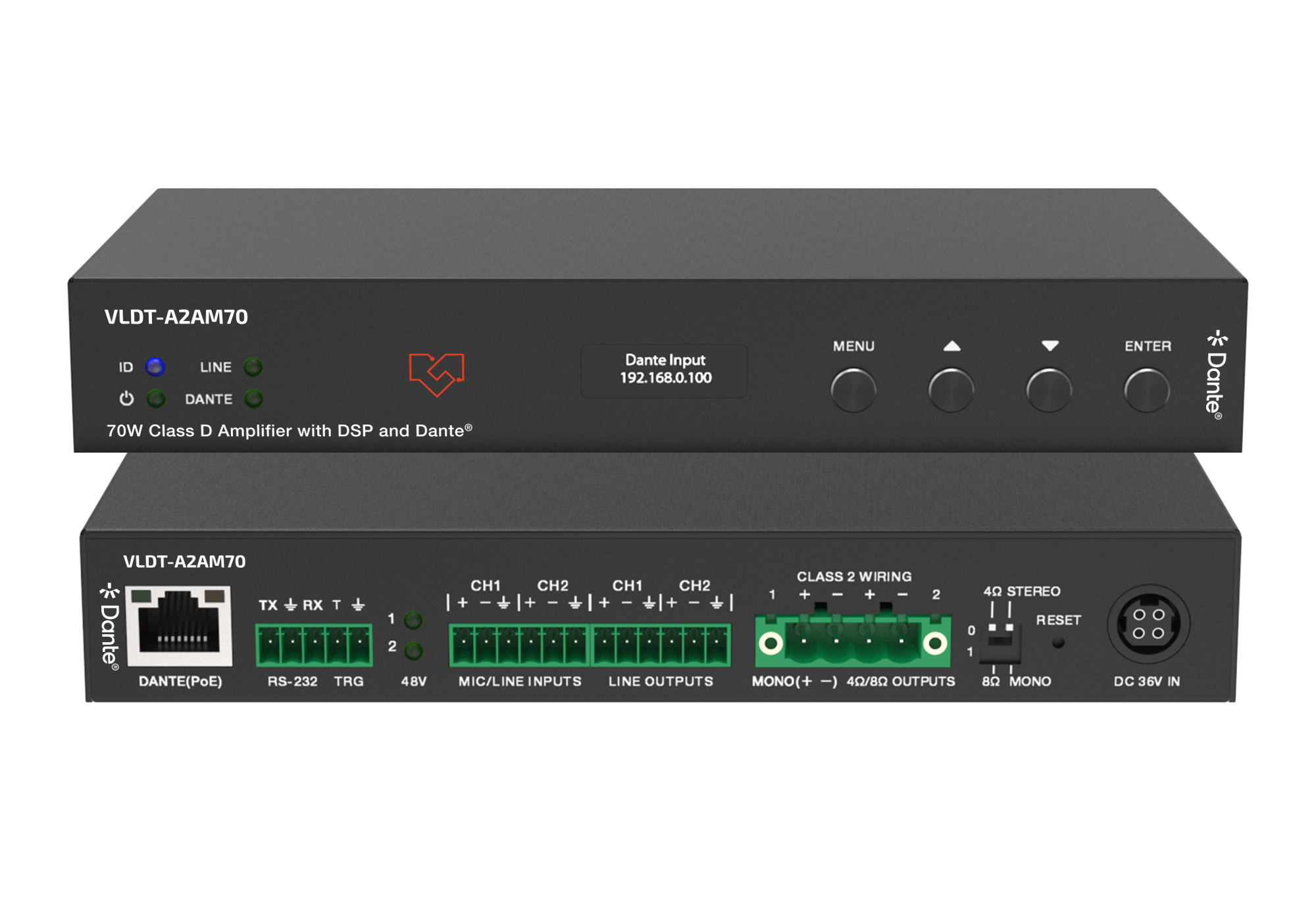
The primary differences are power output and form factor. The VLDT-A2AM30 delivers 2×15W (stereo) or 1×30W (bridged mono) in a compact half-rack form factor, while the VLDT-A2AM70 provides 2×35W (stereo) or 1×70W (bridged mono) in a full 1U rack-mount enclosure. Both models share identical features: Dante® 2x2 audio, balanced mic/line inputs with 48V phantom power, comprehensive DSP processing, web GUI control, and PoE+ support. Choose the A2AM30 for small meeting rooms, retail zones, or installations requiring compact size and moderate power output; choose the A2AM70 for larger spaces, conference rooms, or applications requiring higher SPL and full rack-mount integration.
Why Choose Dante® Networking for Professional AV?
Dante® has become the de facto standard for professional networked audio because it runs on standard Gigabit Ethernet infrastructure that most facilities already have in place. Where traditional analog audio distribution requires dedicated point-to-point wiring for every connection, a single Cat6 cable running to a network switch can carry hundreds of Dante® audio channels simultaneously, dramatically reducing installation complexity and cost.
For AV integrators and system designers, Dante® delivers key practical advantages: any Dante® device on the network can send audio to any other Dante® device without physical rewiring; routing changes are made entirely in software using the free Dante® Controller application; and the open ecosystem of over 600 manufacturers means mixing console, DSP, amplifier, and source products from different brands interoperate seamlessly. The VLDT-A2AM30 integrates into this ecosystem as a network-connected amplifier — receiving audio from any Dante® source, processing it with integrated DSP, and delivering amplified output to local speakers while simultaneously transmitting processed audio back to the network for monitoring or cascading to additional zones.
Get More Product Information or Where to Purchase
Compare Similar Models
-
![VLDT-A2AM30]()
30W Class D Audio Amplifier with Dante® and Line/Mic Inputs
-
![VLDT-A2AM70]()
70W Class D Audio Amplifier with Dante® and Line/Mic Inputs
-
![VLDT-A2AM150]()
150W Class D Audio Amplifier with DSP and Dante®