

Home > HDMI Matrix Switchers > Matrix Switchers with Downscaling
Basic Matrix | Matrix with Audio De-Embedding | Matrix with HDBaseT Extension | Matrix with Downscaling
HDMI Matrix Switchers with Downscaling
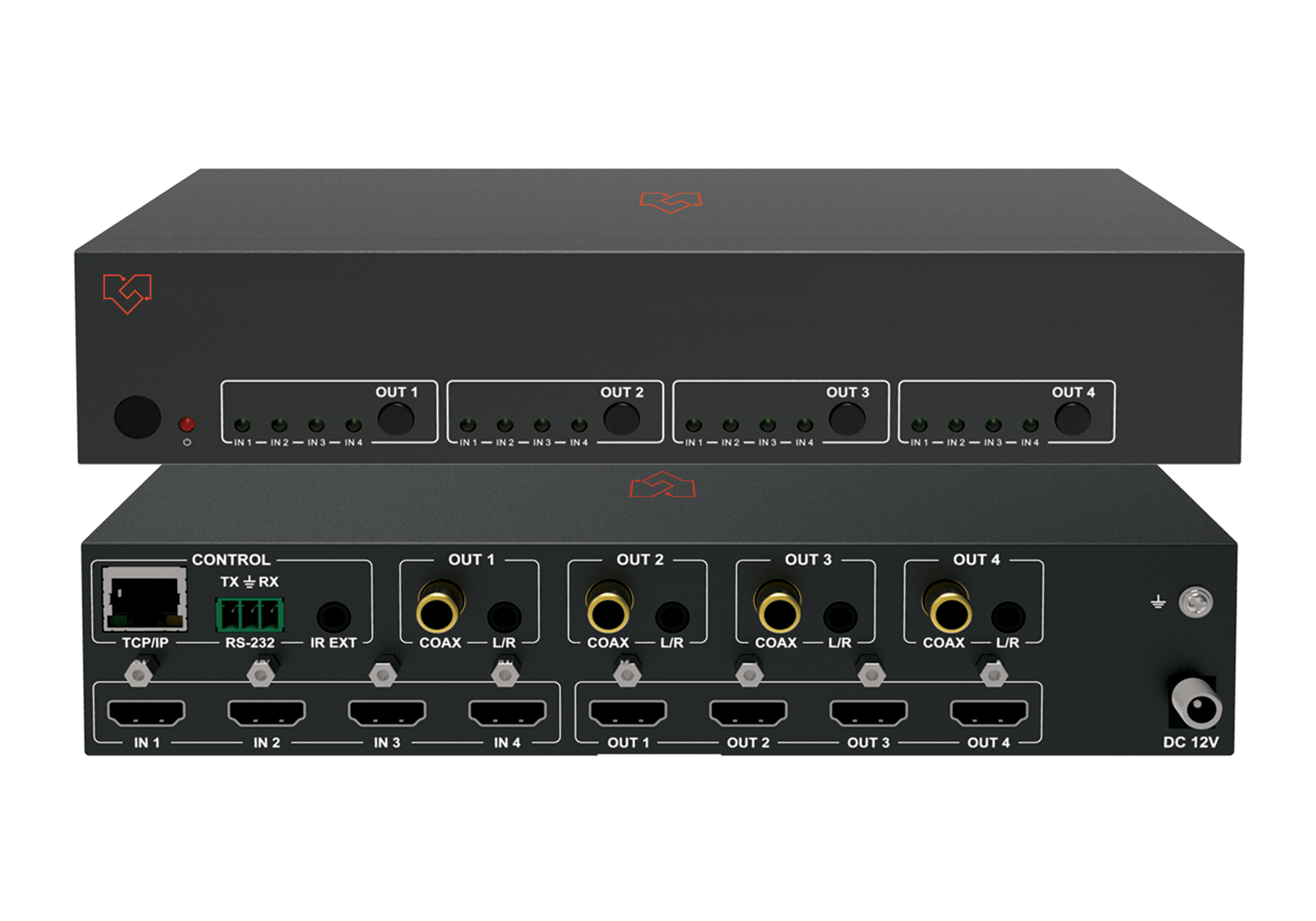
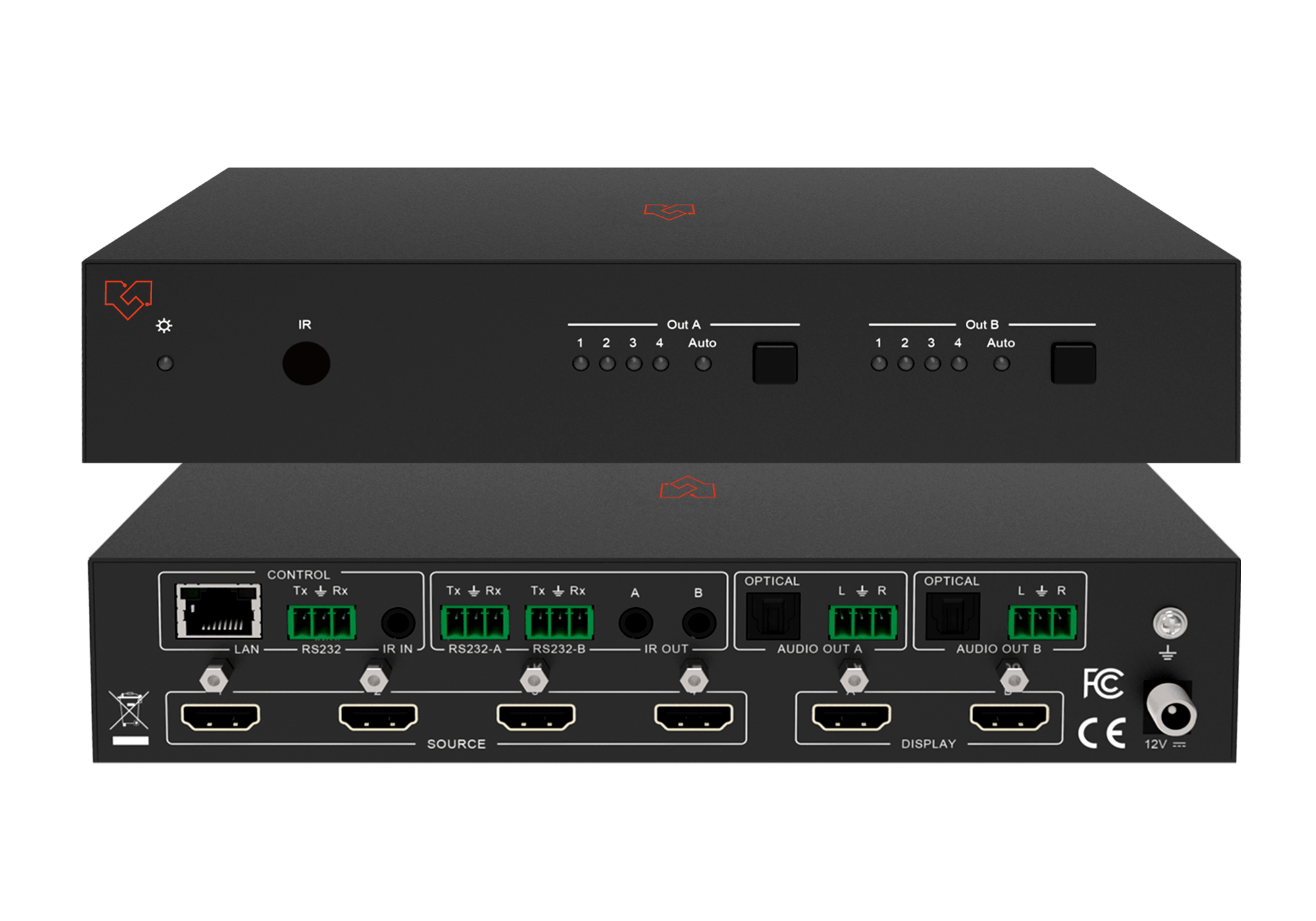
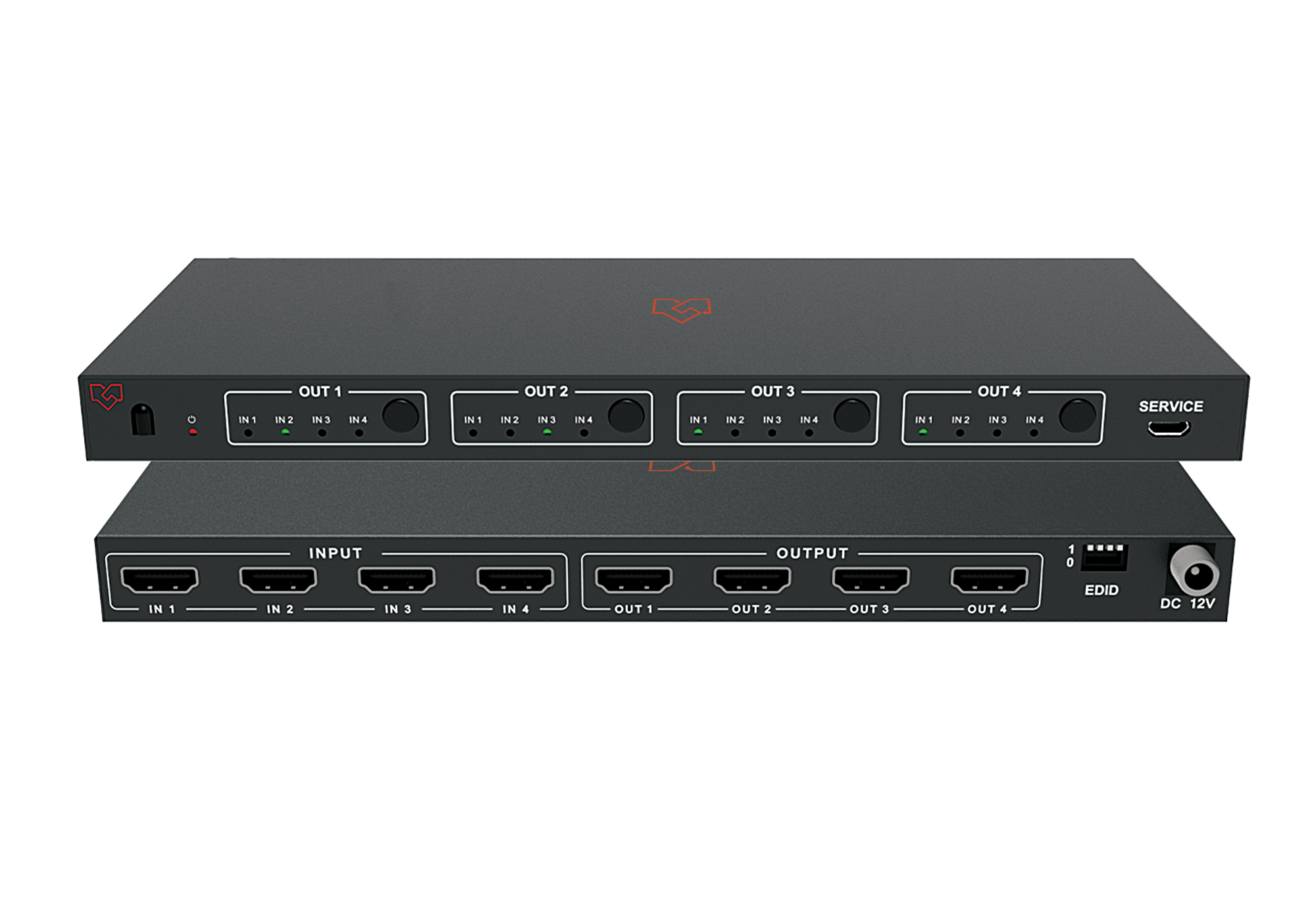
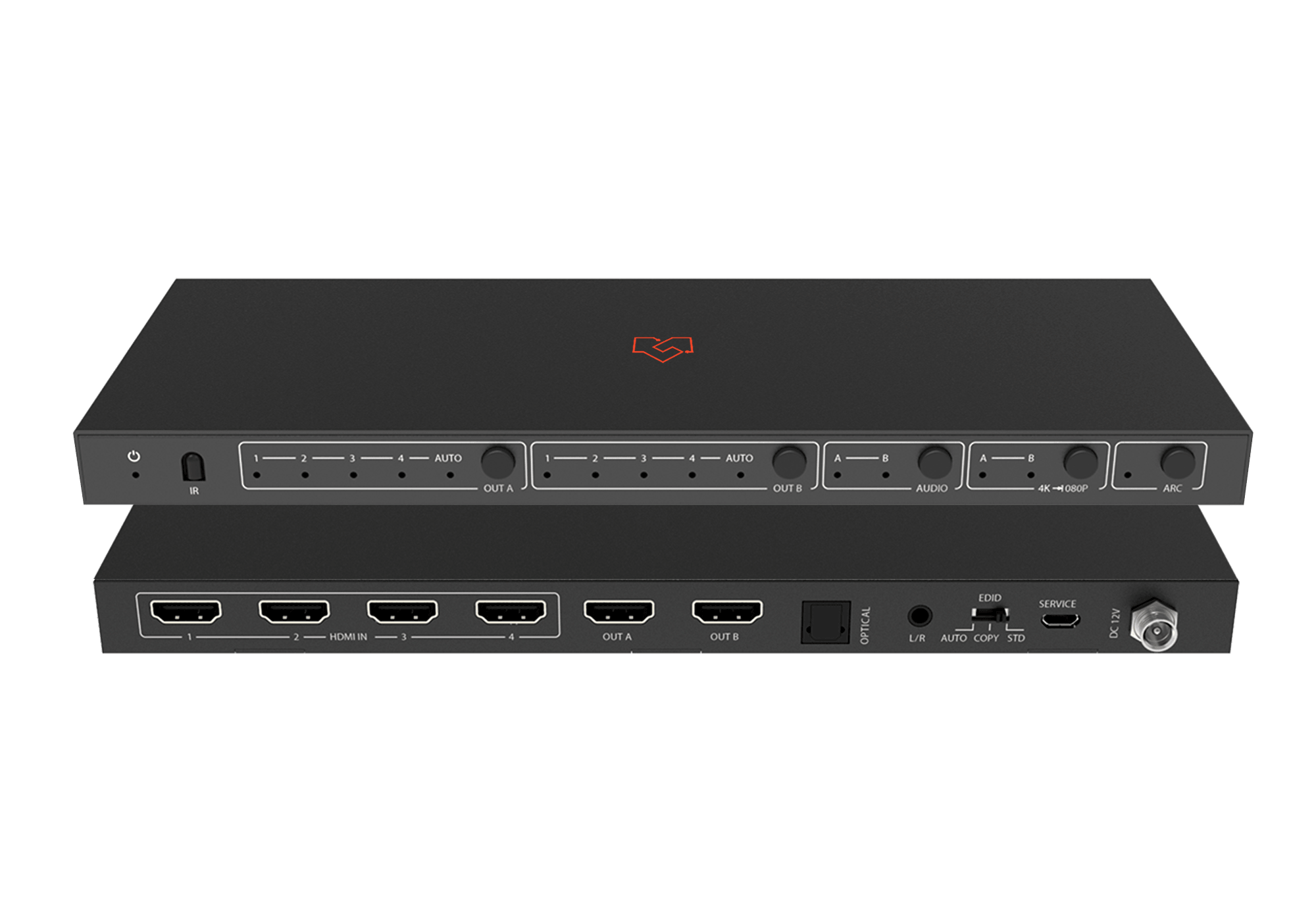
HDMI Matrix Switchers with Downscaling
VigilLink's downscaling matrix switchers provide professional 4K any-to-any routing with the added capability of per-output 4K-to-1080p resolution conversion — enabling a single matrix to simultaneously serve both 4K-capable and legacy 1080p displays without additional scalers in the signal chain. This is particularly valuable in facilities undergoing phased display upgrades, environments where different display types serve different functional purposes within the same AV system, and installations where budget or mounting constraints prevent full 4K display deployment at every output.
All four models operate at full 4K@60Hz HDMI 2.0 18Gbps on every input, with per-output scaling that downconverts to 1080p when connected to 1080p displays while passing full 4K to 4K-capable displays.
Choosing the Right Matrix with Downscaling
VLMX-0402 — 4x2 with downscaling: Four inputs and two outputs, each with per-output 4K-to-1080p downscaling. Choose for dual-display environments — conference rooms with a primary display and a secondary display, dual-monitor digital signage, or any two-output routing requirement where display resolutions differ between outputs.
VLMX-0404 — 4x4 with downscaling: Four inputs and four outputs, each with per-output 4K-to-1080p downscaling. The most commonly specified downscaling matrix for mixed-resolution training rooms, presentation spaces, and facilities with four independent display destinations requiring source-agnostic resolution handling.
VLMX-0402E — 4x2 with downscaling and display control: Identical to the VLMX-0402 with the addition of RS-232 and CEC display control on each output. Choose when the AV system requires automated display power-on/off, display input selection, or other RS-232/CEC control functions that would otherwise require a separate control system component at each display.
VLMX-0404E — 4x4 with downscaling and display control: Identical to the VLMX-0404 with RS-232 and CEC display control on each of four outputs. The full-featured option for four-output mixed-resolution installations requiring integrated display management. Choose when minimizing control system complexity while maintaining full display power and input management is a design priority.
Frequently Asked Questions
What does per-output downscaling mean in a matrix switcher? Per-output downscaling means that each individual output port on the matrix can independently convert the incoming 4K signal to 1080p before sending it to the connected display. This allows a single matrix to simultaneously send 4K to outputs connected to 4K displays and 1080p-downscaled signals to outputs connected to 1080p displays — without any additional hardware between the matrix and the display. The downscaling decision is made independently at each output based on the connected display's capabilities.
Can each output be set independently between 4K passthrough and 1080p downscaling? Yes. On VigilLink downscaling matrix models, each output is independently configurable for 4K passthrough or 1080p downscaling. This allows a 4x4 downscaling matrix to simultaneously send native 4K to two outputs and downscaled 1080p to the other two — or any other combination — based on the display type at each output location.
What is the difference between the VLMX-0404 and VLMX-0404E? The VLMX-0404E adds RS-232 and CEC display control to each output, enabling the matrix to send display power, input selection, and control commands to connected displays via the HDMI cable (CEC) or a separate RS-232 connection. The VLMX-0404 does not include this display control capability. Both models are otherwise identical in video switching, downscaling, and general control specifications.
Does downscaling affect the quality of the 4K signal at 4K outputs? No. Downscaling is applied only to outputs where it is configured or where the connected display reports 1080p as its native resolution. Outputs connected to 4K displays receive the full 4K@60Hz 18Gbps signal without any scaling or processing applied. The 4K source signal enters the matrix at full bandwidth and is preserved until each output's resolution decision is made independently.
What is CEC display control and how does it work through the HDMI cable? CEC (Consumer Electronics Control) is an HDMI feature that allows connected devices to send control commands over the HDMI cable without a separate control wire. On VLMX-0402E and VLMX-0404E models, the matrix can issue CEC commands — such as display power on/off and input selection — to CEC-enabled displays connected to each output. CEC reach and reliability vary by display manufacturer and firmware; RS-232 display control (also included on E-suffix models) provides a more deterministic alternative for professional display control applications.
Do downscaling matrix switchers support HDCP 2.2 for protected 4K content? Yes. All VigilLink downscaling matrix switchers support HDCP 2.2 on all inputs and outputs, enabling passthrough of protected 4K UHD content from Blu-ray players, streaming devices, and other HDCP 2.2 sources. When output is downscaled to 1080p, HDCP 1.4 protection is applied at the 1080p output if the connected display supports it.
Is there an 8x8 downscaling matrix in the VigilLink lineup? The current downscaling matrix family includes 4x2 and 4x4 configurations (VLMX-0402, VLMX-0404, VLMX-0402E, VLMX-0404E). For higher port counts requiring downscaling in a larger matrix, contact VigilLink to discuss current product availability and project requirements. For installations where all displays are 4K-capable, the basic HDMI matrix family (VLMX-0808E, VLMX-1616E) provides 8x8 and 16x16 capacity at full 4K throughput.
Can the VLMX-0404E control display power automatically when switching sources? Yes. On the VLMX-0404E, display control commands — including power on/off — can be configured to trigger automatically on routing events. For example, the matrix can be programmed to power on the display connected to a specific output when that output is assigned an active source, and power it off when no source is routed to that output. This automation reduces the number of manual steps operators must perform during a switching workflow and enables unattended display management in digital signage and scheduled presentation environments.