

Home > GeoBox Immersive Spaces > Image Warping
Edge Blending | Projection Mapping | Image Warping | Video Wall Processors | Multi-View Switchers & Splitters | 3D Processors


GeoBox Image Warping Processors | Geometry Correction for Any Surface



About GeoBox Image Warping Processors
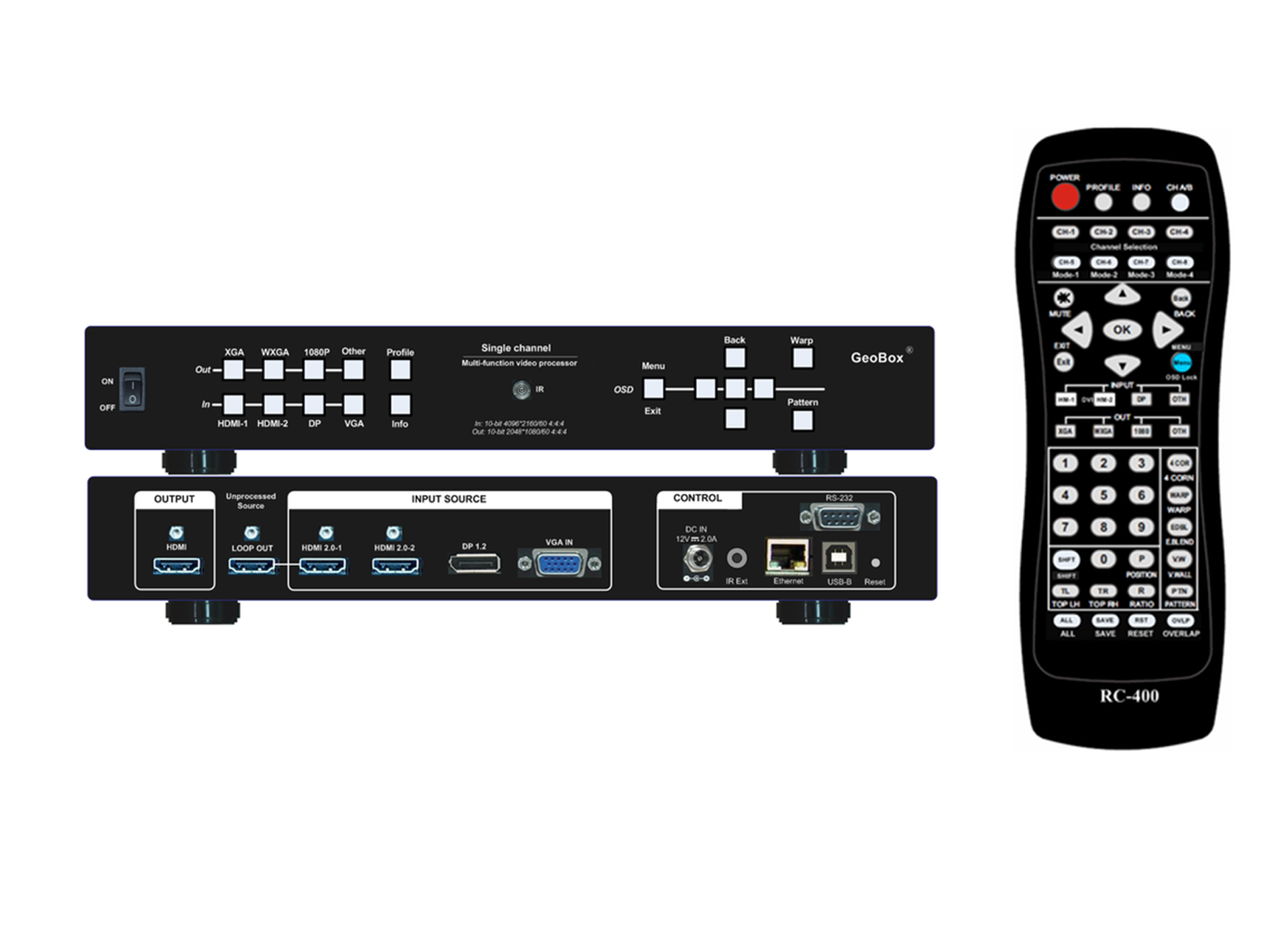
Image warping bends and reshapes a projected image so it lands correctly on a surface the projector isn't aimed squarely at — a curved screen, a corner, a tilted or off-axis wall, or an ultra-short-throw setup. GeoBox warping processors apply grid-based geometry correction, rotation, and cropping to a single channel, straightening distortion that keystone alone can't fix and stacking or aligning the image precisely on the target. Each unit is a standalone, one-box solution: geometry, rotation, and cropping are configured over IR remote, an RS-232/Ethernet PC tool, or a built-in WebGUI, then run 24/7 on dedicated hardware with no resident PC software in the signal path.
The range spans a compact mini processor (G111), a full-featured 4K2K-in warping processor with PIP/POP (M811L), and an 8K2K-in warping processor with a multi-viewer (UD101L) — all TAA compliant for government, simulation, and defense installations.
Choosing the Right Image Warping Processor
All three are single-channel warping processors. Choose by input resolution and whether you need PIP/POP or an on-screen multi-viewer.
Mini warping (G111): A compact 1-channel mini warping processor with image rotation and cropping, offering grid-based geometry correction in the smallest, most cost-effective form. Choose the G111 for straightforward distortion correction on a single projector — corner mounting, tilted surfaces, and portrait installs.
4K warping with PIP/POP (M811L): A 1-channel processor accepting 4K2K input and outputting 2048×1080, adding picture-in-picture and picture-outside-picture layouts on top of image rotation and cropping. Choose the M811L when a single warped output also needs to composite a second source, or when the install calls for more layout flexibility than the mini unit provides.
8K warping with multi-viewer (UD101L): The highest-resolution tier — 1-channel 8K2K in / 4K2K out with an integrated multi-viewer. Choose the UD101L when the source is 8K, or when operators need a monitoring overlay alongside the warped output.
Selection guidance: Match the processor to the source resolution first — G111 and M811L for FHD/4K-class sources, UD101L for 8K. Step up from the G111 to the M811L when you need PIP/POP compositing, and to the UD101L when you need 8K input or a multi-viewer.
Frequently Asked Questions
What is image warping, and how is it different from keystone correction?
Image warping reshapes a projected image across a grid of control points so it fits a curved, angled, or off-axis surface precisely. Basic keystone correction only fixes simple trapezoidal distortion from vertical or horizontal tilt; warping corrects complex, non-linear geometry that keystone cannot — such as curved screens, corners, and irregular mounts.
When do I need a dedicated warping processor?
You need one whenever a projector cannot be aimed squarely at a flat screen — ultra-short-throw and off-axis mounting, curved or corner surfaces, portrait orientation, or stacked/aligned multi-projector setups — and the projector's built-in correction isn't precise enough. A GeoBox warping processor applies grid-based geometry, rotation, and cropping to straighten the image.
Do GeoBox warping processors need a PC or software?
No. All geometry, rotation, and cropping settings run in dedicated hardware, so the processor operates continuously without a host computer or resident software. A PC, IR remote, or WebGUI is used only for initial setup and can then be disconnected, which suits unattended, 24/7 installations.
Which warping processor should I choose?
Choose the G111 for compact single-projector distortion correction, the M811L when you also need PIP/POP compositing on a 4K2K-in source, and the UD101L when the source is 8K or an on-screen multi-viewer is required. All three are single-channel, TAA compliant, and configured without software.
What is the difference between the M811L and the UD101L?
Both are single-channel warping processors. The M811L accepts 4K2K input, outputs 2048×1080, and adds PIP/POP layouts with rotation and cropping. The UD101L steps up to 8K2K input with 4K2K output and an integrated multi-viewer, making it the choice for native 8K sources and monitoring overlays.
Can these processors rotate the image for portrait installations?
Yes. All three include image rotation, so content can be turned for portrait or angled displays, and cropping lets you trim the output to the exact area of the target surface — useful for pillars, signage columns, and irregular mounts.