

Home > HDMI Switchers > HDMI Switchers with Audio De-Embedding
HDMI Switchers with Audio De-Embedding | Basic HDMI Switchers | HDMI Switchers with ARC
8K 48 Gbps HDMI Switchers with Audio De-Embedding

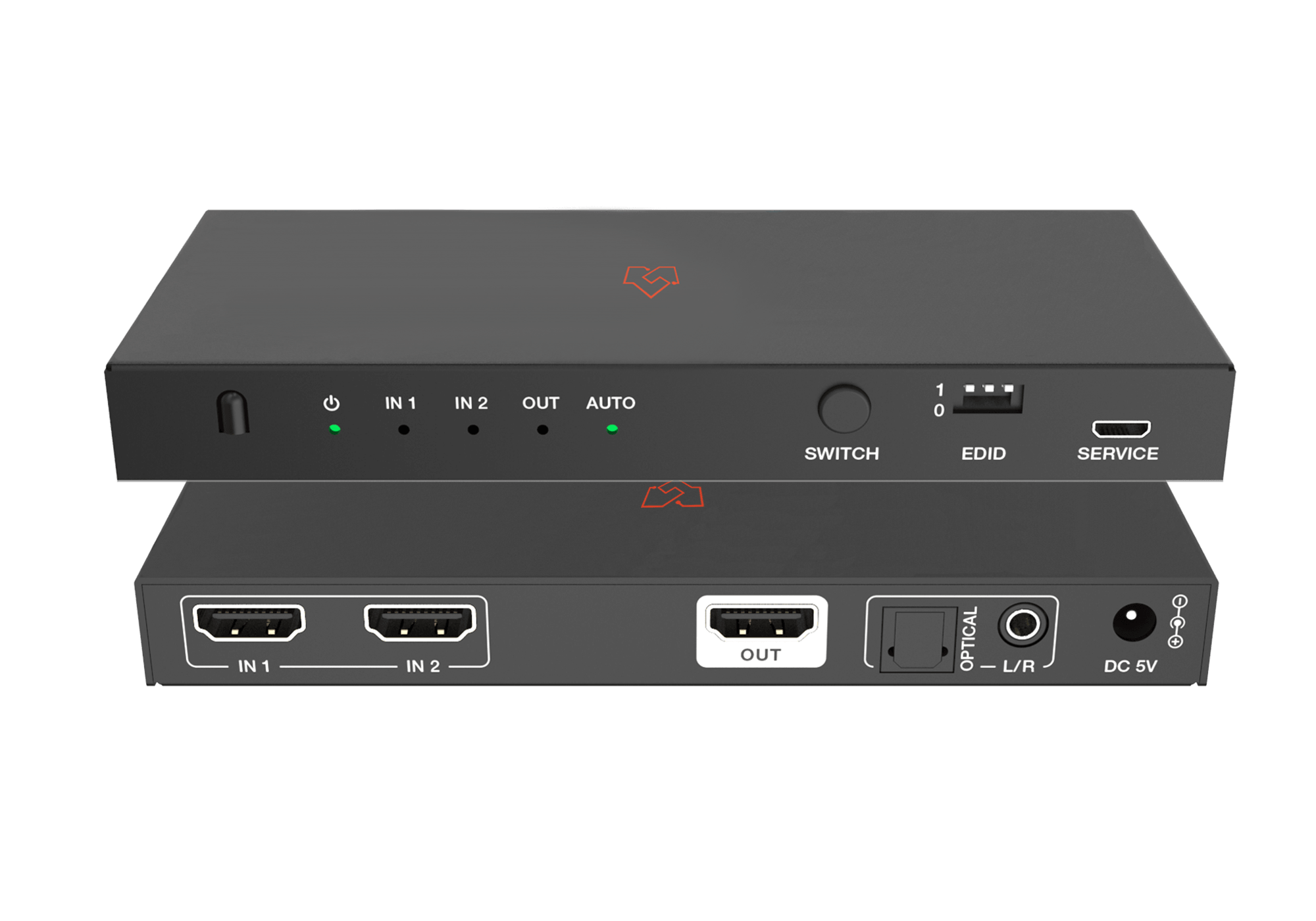
About HDMI Switchers with Audio De-Embedding
VigilLink's audio de-embedding HDMI switchers solve a specific and common professional AV problem: routing HDMI video from multiple sources to a single display while simultaneously extracting audio for a separate room sound system. The lineup now spans four models across two tiers.
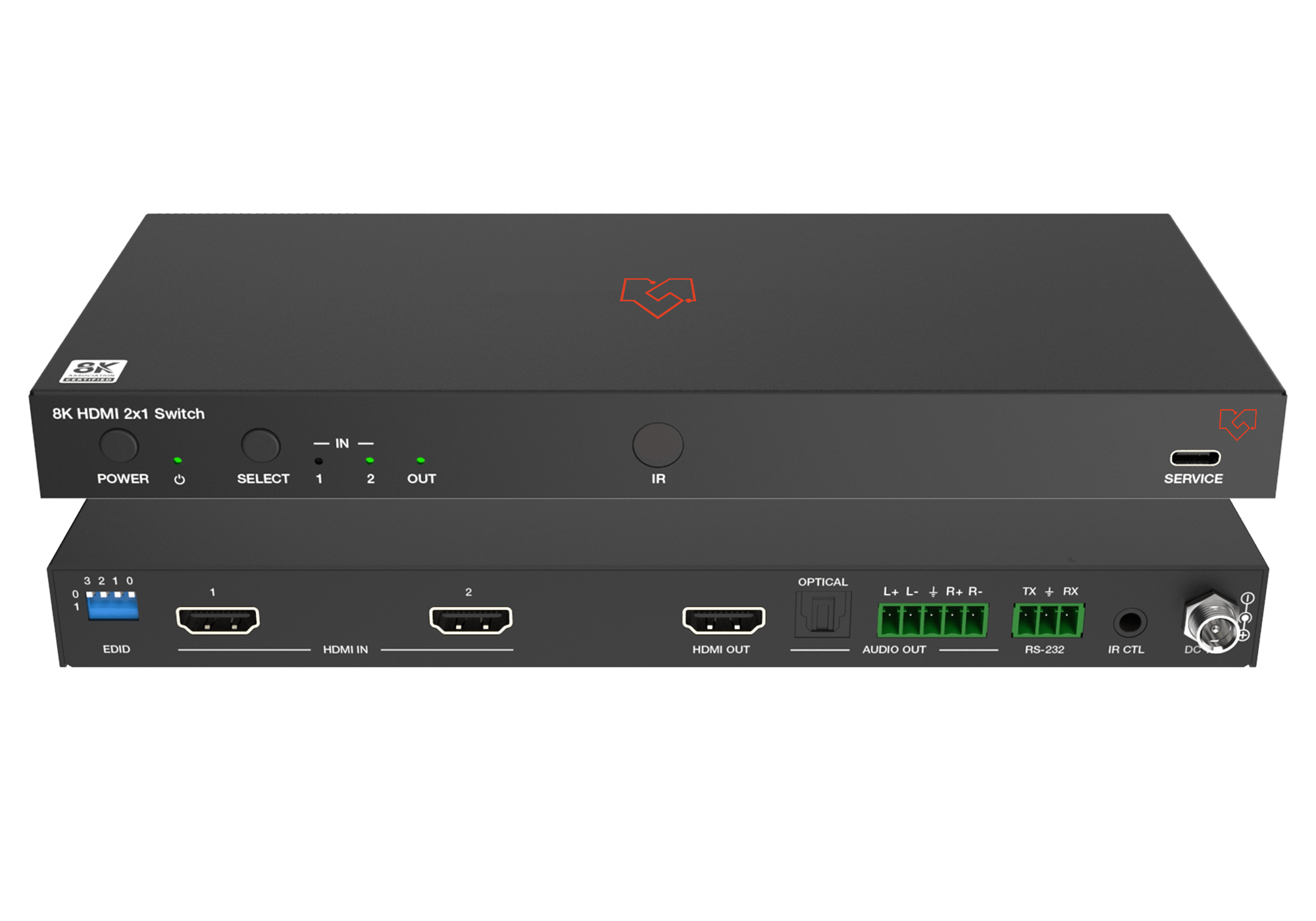
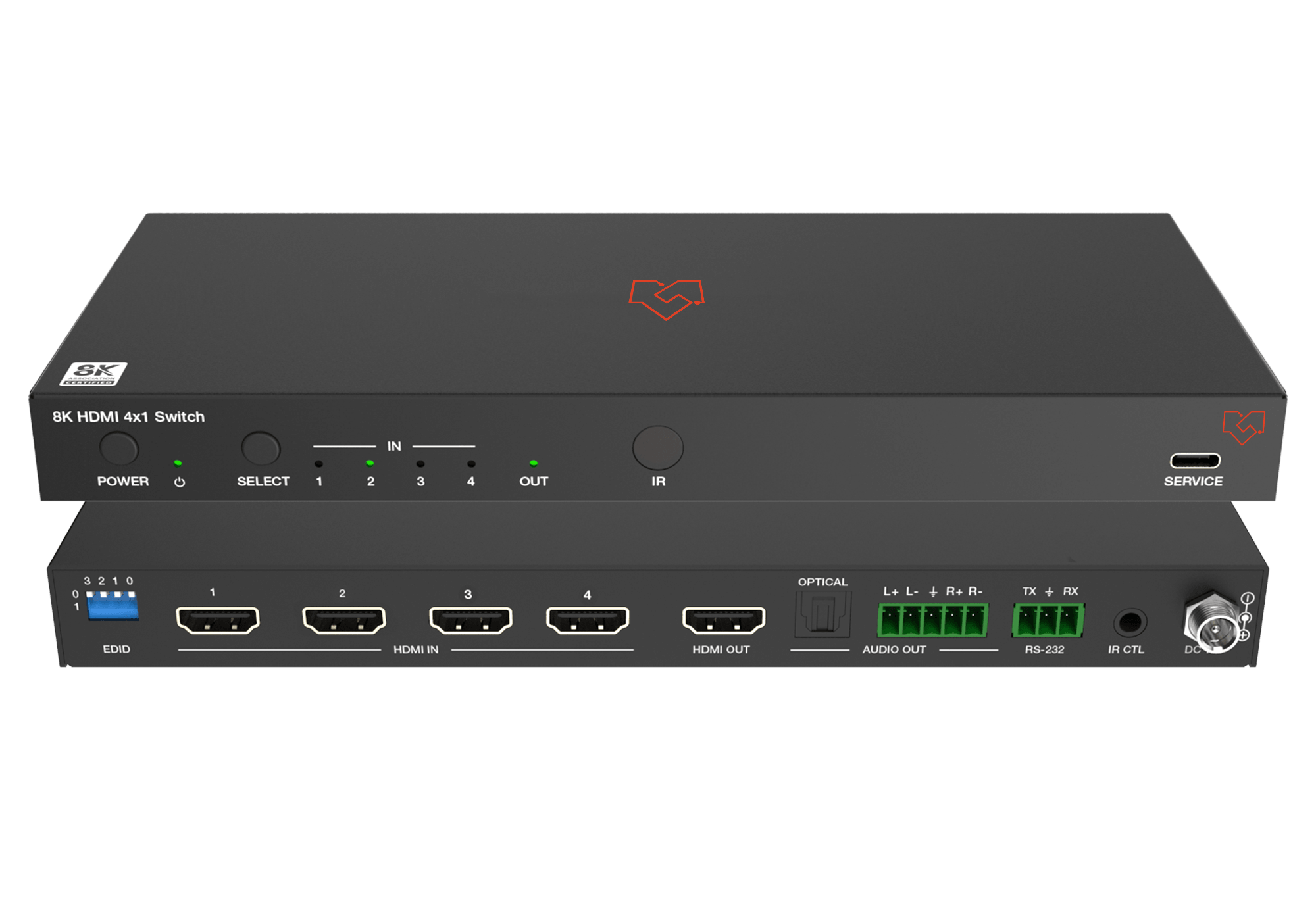
The VLSW-2x18KA (2x1) and VLSW-4x18KA (4x1) are professional-grade units adding RS-232 API control, 4-position DIP switch EDID management, and a built-in HDMI signal generator — designed for installations integrated with Crestron, AMX, Extron, or Q-SYS control systems.
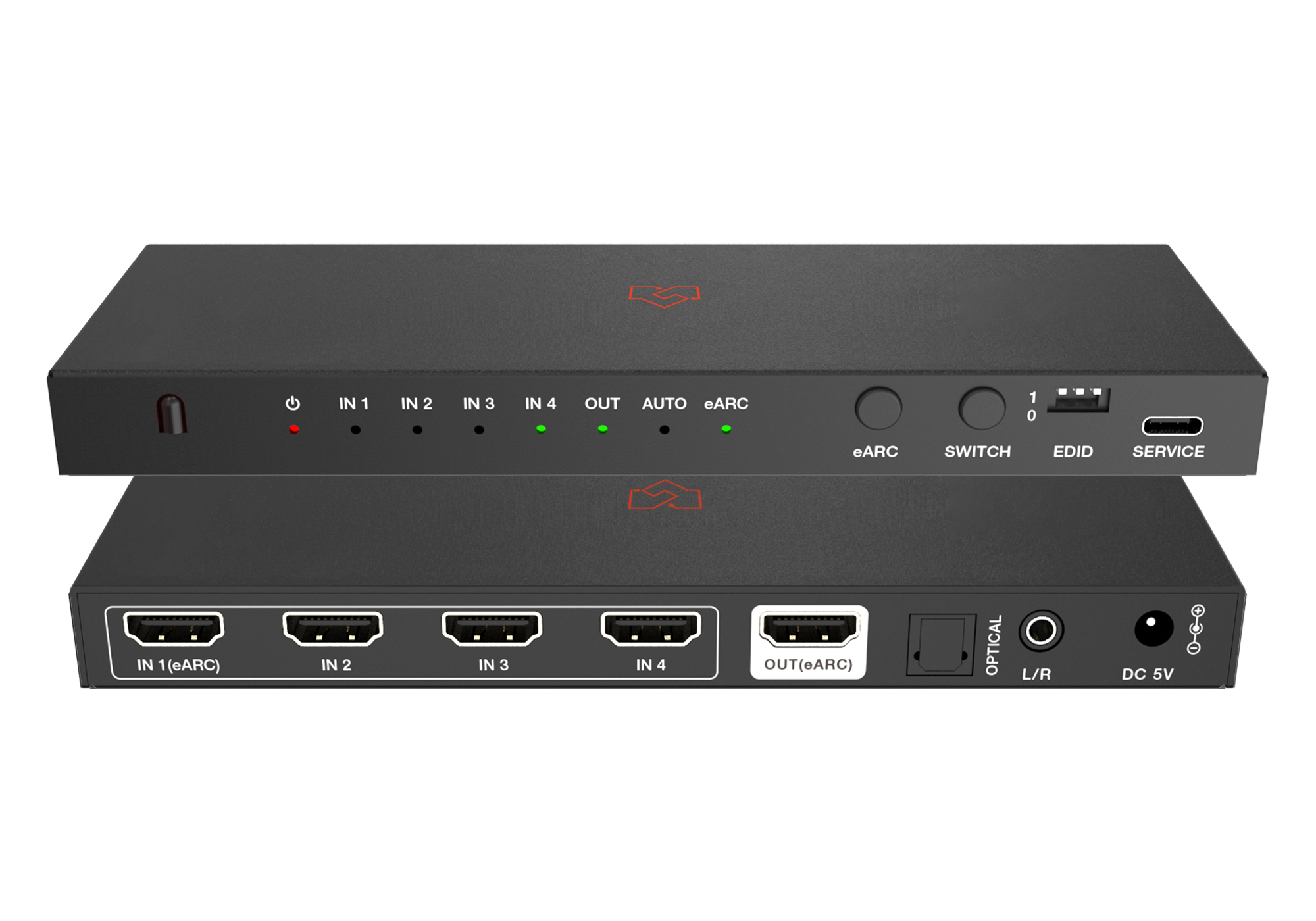
The VLSW-21H21A (2x1) and VLSW-41H21A (4x1) are compact units suited for straightforward source switching with audio breakout. All four operate at the full 48Gbps HDMI 2.1 bandwidth — supporting 8K@60Hz, 4K@120Hz, VRR, ALLM, and Dolby Vision — and de-embed audio simultaneously to optical S/PDIF and analog stereo outputs without any separate extractor in the signal chain.
Choosing the Right HDMI Switcher with Audio De-Embedding
2x1 with RS-232 & EDID Management — VLSW-2x18KA: Two HDMI 2.1 inputs, one HDMI 2.1 output, optical S/PDIF and analog L/R stereo via 5-pin Phoenix connector with adjustable gain. Adds 4-position DIP switch EDID management, built-in signal generator, and RS-232 API via 3-pin Phoenix connector. Choose the VLSW-2x18KA for two-source installations requiring control system integration or managed EDID — boardrooms, lecture halls, digital signage, or broadcast monitor positions where a control processor drives source selection.
4x1 with RS-232 & EDID Management — VLSW-4x18KA: Four HDMI 2.1 inputs with the same professional feature set as the VLSW-2x18KA: DIP switch EDID, RS-232 control, signal generator, and Phoenix analog audio output. Choose the VLSW-4x18KA when four sources must share a single display and the installation is integrated with an external control system.
2x1 Compact — VLSW-21H21A: Two HDMI 2.1 inputs, one HDMI 2.1 output, optical TOSLINK and analog stereo (3.5mm) audio outputs. No RS-232 port. Choose the VLSW-21H21A for two-source installations where simple front-panel or IR switching with audio breakout is sufficient and control system integration is not required.
4x1 Compact — VLSW-41H21A: Four HDMI 2.1 inputs with the same compact form factor and audio extraction as the VLSW-21H21A. Choose the VLSW-41H21A for four-source rooms that need audio de-embedding without the overhead of RS-232 control or EDID management.
Frequently Asked Questions
What audio formats do the VLSW-21H21A and VLSW-41H21A de-embed?
Both models extract the embedded HDMI audio stream and output it simultaneously as analog stereo (L/R), optical TOSLINK (S/PDIF), and coaxial S/PDIF. The audio format carried on the optical and coaxial outputs reflects the audio format present in the HDMI stream — PCM stereo, Dolby Digital 5.1, or DTS 5.1 where the source and receiver support it. Lossless formats (Dolby TrueHD, DTS-HD MA) are typically downmixed to their core lossy format on de-embedded outputs.
Does de-embedding audio affect video quality or latency?
No. Audio de-embedding is a passive extraction process on the HDMI data stream — the video signal is passed through to the HDMI output at full 48Gbps bandwidth with no degradation, no added compression, and no measurable latency increase. The HDMI output and all audio outputs operate simultaneously and independently.
Can I use the analog audio output with a standard amplifier?
Yes. The analog stereo output on the VLSW-21H21A and VLSW-41H21A is a standard line-level signal compatible with any amplifier, mixer, or DSP processor that accepts an analog stereo input. No special converter or adapter is required between the switcher's analog output and a room amplifier input.
Do these switchers support HDCP 2.3 and protected 4K content?
Yes. Both models support HDCP 2.3, ensuring compatibility with protected 4K and 8K content from streaming devices, Blu-ray players, and gaming consoles. HDCP compliance is maintained at every HDMI input and the HDMI output, and is not affected by the audio de-embedding function.
What happens to audio when I switch from one input to another?
When the active input changes, the de-embedded audio outputs immediately switch to reflect the audio of the newly selected source. There is no independent audio routing — the audio de-embedding tracks the selected video input. If independent audio routing is required (routing audio from a different source than the video), a separate audio matrix or DSP with HDMI inputs would be needed.
Are these switchers compatible with 8K displays and HDMI 2.1 sources?
Yes. The VLSW-21H21A and VLSW-41H21A operate at the full 48Gbps HDMI 2.1 bandwidth, supporting 8K@60Hz, 4K@120Hz, VRR (Variable Refresh Rate), ALLM (Auto Low Latency Mode), and Dolby Vision. They are also fully backward compatible with HDMI 2.0 and HDMI 1.4 sources and displays.
What is the difference between optical TOSLINK and coaxial S/PDIF audio outputs?
Both optical TOSLINK and coaxial S/PDIF carry the same S/PDIF digital audio signal — the difference is the physical connection type. Optical TOSLINK uses a fiber optic cable and is immune to electrical interference; coaxial S/PDIF uses an RCA-style cable and can transmit over longer distances. Having both outputs simultaneously allows the VLSW-21H21A and VLSW-41H21A to connect to different audio equipment types without a separate optical-to-coaxial converter.
Can I control input selection via IR remote or control system?
All four models support front-panel button input selection and IR remote control. The VLSW-2x18KA and VLSW-4x18KA additionally include RS-232 API control via a 3-pin Phoenix connector, providing full integration with Crestron, AMX, Extron, Control4, Q-SYS, and any control system that issues serial commands — input selection, switching mode, and status queries are all RS-232 controllable. The VLSW-21H21A and VLSW-41H21A use front-panel and IR control only; for RS-232 integration on those models, consult VigilLink for availability.