

Home > Multi-View Processors > Multi-View Matrix with Video Walls
Multi-View Matrix with Video Walls | Multi-View Matrix | HDMI Multiviewers
Multi-View Matrix Switchers with Video Walls

About VigilLink Multi-View Matrix Switchers with Video Walls
Multi-view matrix switchers with video wall combine three functions in a single unit: seamless matrix routing, multi-source display on one screen, and a tiled video wall that spans one image across several displays. Where a standard multiviewer drives a single monitor and a matrix switcher sends one source per output, these units do both and add wall tiling on top, so the same chassis can route sources independently, show several at once in a window layout, or join a bank of screens into one continuous picture.
VigilLink's range covers two configurations built on this shared capability. Both switch and multiview at up to 4K60 4:4:4 over 18Gbps and drive their video walls from the same outputs used for routing, so an installation can shift between a spanned wall and independent source windows without additional hardware. The difference between them is scale and connectivity: how many displays the wall spans, and what audio and control routing each provides.
Choosing the Right Multi-View Matrix with Video Wall
Both models route, multiview, and tile a video wall. Select by display count and the audio and control routing the installation needs.
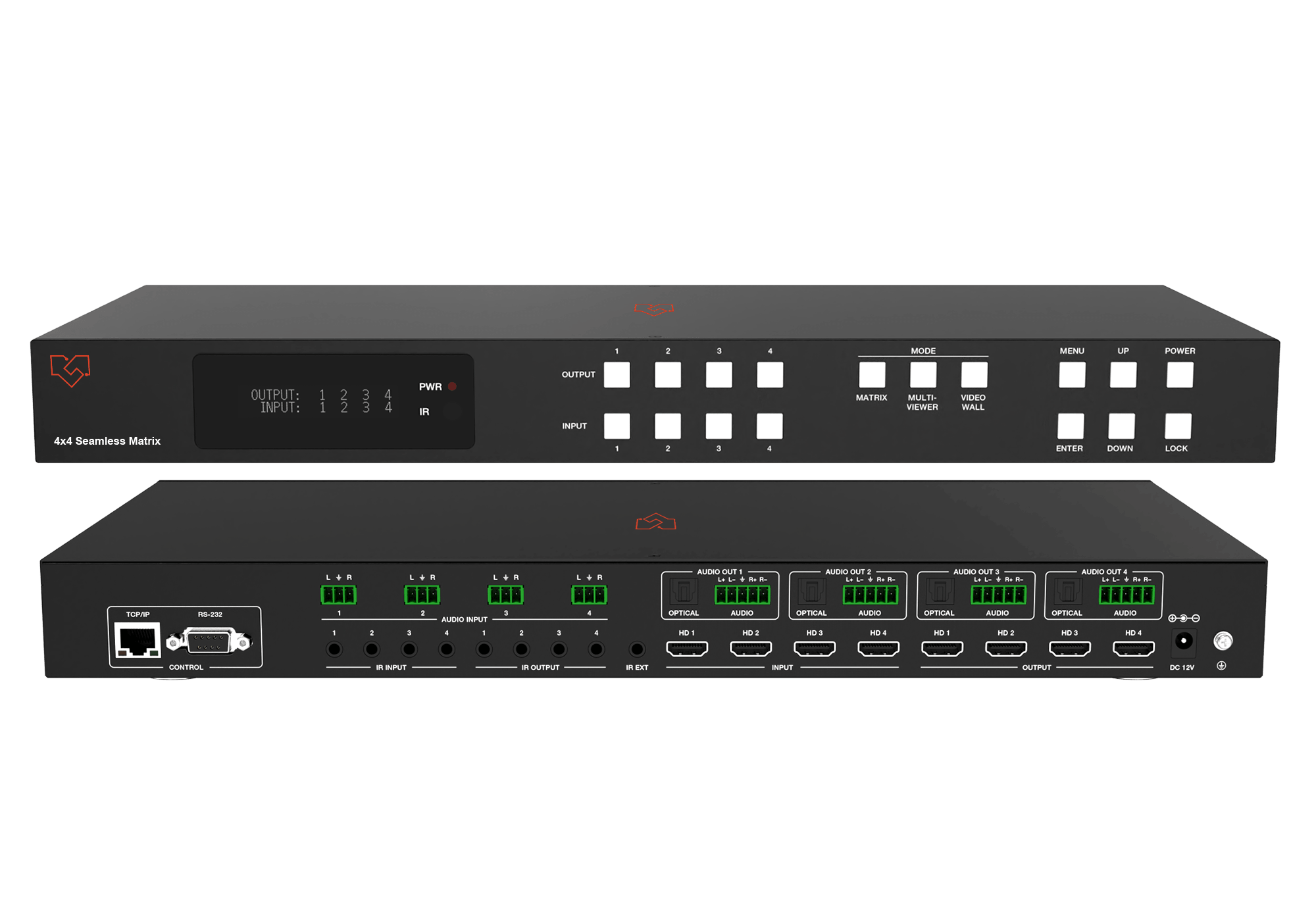
VLML-4x4AM (up to four displays): A 4x4 seamless matrix that tiles a video wall across four screens using ten built-in splicing modes, from 2x2 and 1x4 to an independent Matrix layout. It adds audio embedding as well as de-embedding, and a 4x4 IR matrix that routes IR control alongside video. It suits control positions, signage, and boardrooms where four displays cover the wall and IR routing or audio insertion is part of the design.
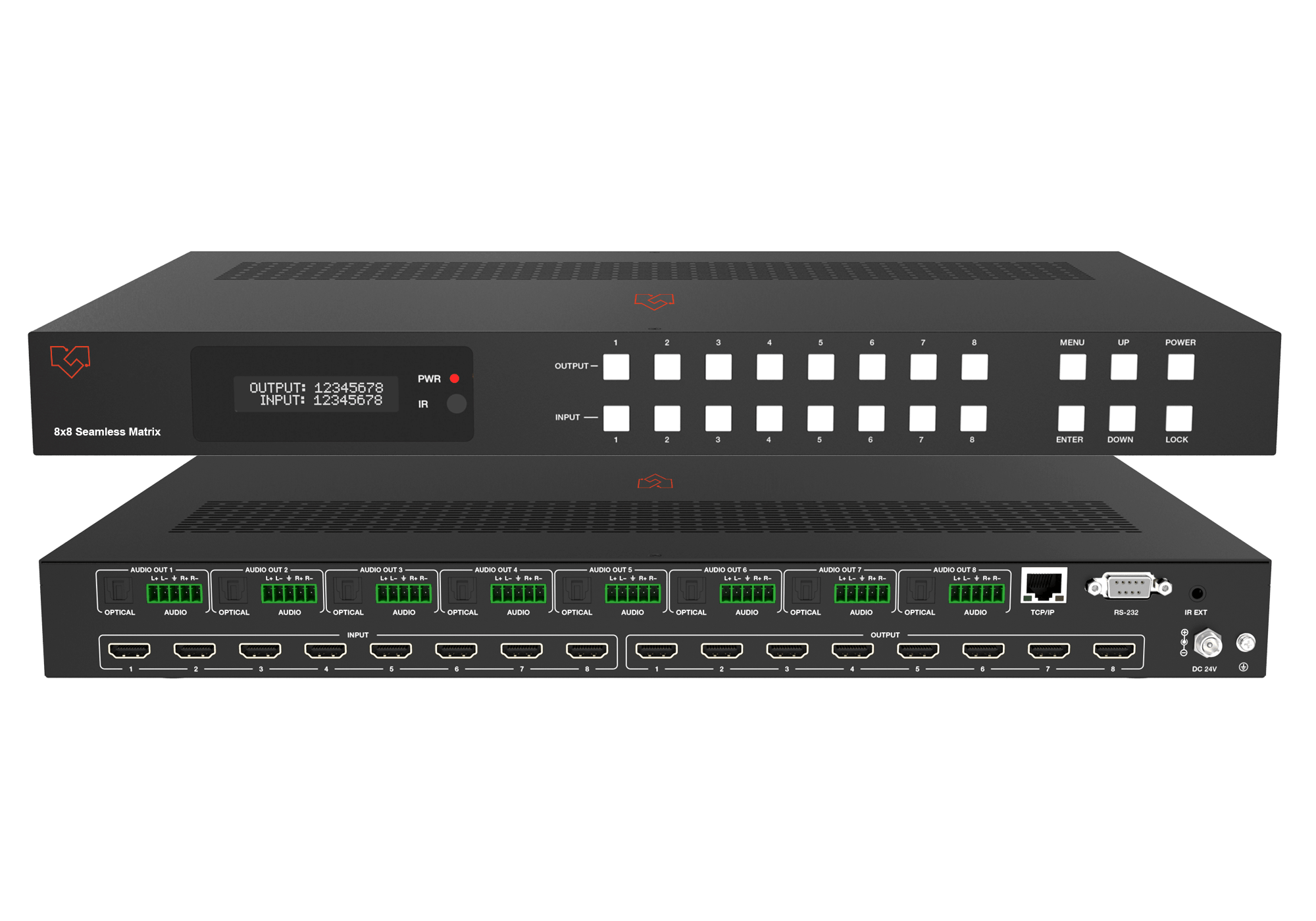
VLML-8x8AM (up to eight displays): An 8x8 seamless matrix that tiles a video wall across up to eight screens in a freeform rows-by-columns layout, with per-screen horizontal and vertical bezel correction that closes the seams for one continuous picture. It provides eight optical and eight balanced analog audio outputs for zoned sound. It suits larger walls and distribution rooms where the wall geometry needs to be arbitrary and audio must reach multiple zones.
Key selection variable: the deciding factor is wall size. Choose the VLML-4x4AM when four displays cover the wall and you want audio embedding or IR routing, and the VLML-8x8AM when the wall runs up to eight displays, the layout needs freeform rows-by-columns geometry with bezel correction, or the room needs eight-channel audio distribution.
Frequently Asked Questions
What is a multi-view matrix switcher with video wall?
It is a single unit that combines seamless matrix routing, multi-source display on one screen, and a tiled video wall that spans one image across several displays. The same outputs used for routing also drive the wall, so one chassis handles independent routing, windowed multiview, and a continuous spanned picture.
How is this different from the Multi-View Matrix subcategory?
Both route to multiple outputs and offer multiview. The models in this subcategory add tiled video wall, joining several displays into one image. If you do not need a spanned wall, the Multi-View Matrix subcategory covers routing and multiview on its own.
Which models are in this range?
Two: the VLML-4x4AM, a 4x4 seamless matrix with video wall for up to four displays, and the VLML-8x8AM, an 8x8 seamless matrix with video wall for up to eight displays.
How many displays can each video wall span?
The VLML-4x4AM spans up to four displays, one per output. The VLML-8x8AM spans up to eight displays, one per output, in any rows-by-columns arrangement.
What is the difference between the VLML-4x4AM and the VLML-8x8AM?
The VLML-4x4AM drives four displays using ten built-in splicing modes and adds audio embedding and a 4x4 IR matrix. The VLML-8x8AM drives up to eight displays with a freeform rows-by-columns wall and per-screen bezel correction, and provides eight optical and eight balanced audio outputs.
Can I correct for display bezels on the video wall?
The VLML-8x8AM provides per-screen horizontal and vertical bezel correction so content aligns across panel seams. The VLML-4x4AM builds its wall from ten fixed splicing modes.
Do these units also provide multiview?
Yes. Both offer twelve multiview layout categories, including single, picture-in-picture, dual, triple, quad, and user-defined windows, showing multiple sources on one display.
Can they switch and route like a standard matrix switcher?
Yes. Both are seamless matrix switchers first, routing any input to any output with no frame loss, and the video wall and multiview modes run on the same hardware.
What audio outputs do they provide?
The VLML-4x4AM embeds audio from four analog inputs and de-embeds to four optical and four balanced analog outputs. The VLML-8x8AM de-embeds to eight optical and eight balanced analog outputs.
How are they controlled?
Both are controlled from the front panel, IR remote, RS-232, and a built-in web GUI over TCP/IP.