

Home > HDMI Matrix Switchers > Matrix with Audio De-Embedding
Basic Matrix | Matrix with Audio De-Embedding | Matrix with HDBaseT Extension | Matrix with Downscaling
HDMI 2.1 Matrix Switchers with Audio De-Embedding

About Matrix Switchers with Audio De-Embed
VigilLink's audio de-embedding matrix family is built on HDMI 2.1 at the full 48Gbps bandwidth, supporting 8K@60Hz 4:2:0, 8K@30Hz 4:4:4, and 4K@120Hz 4:4:4 with HDCP 2.3, HDR10+, Dolby Vision, and the complete VRR/ALLM/QMS/QFT/SBTM feature set. Every output carries its own optical S/PDIF port (LPCM 2.0CH, Dolby/DTS 5.1CH) and its own balanced analog port on a 5-pin 3.81mm Phoenix connector (LPCM 2CH), plus independent resolution downscaling and HDR-to-SDR conversion. De-embedded audio can be bound to inputs, bound to outputs, or routed as a fully independent audio matrix — including ARC return audio from any connected display. The range is available in 4x4 and 8x8, both fit a 1U rack enclosure with a 6-year VigilLink warranty.
Choosing the Matrix
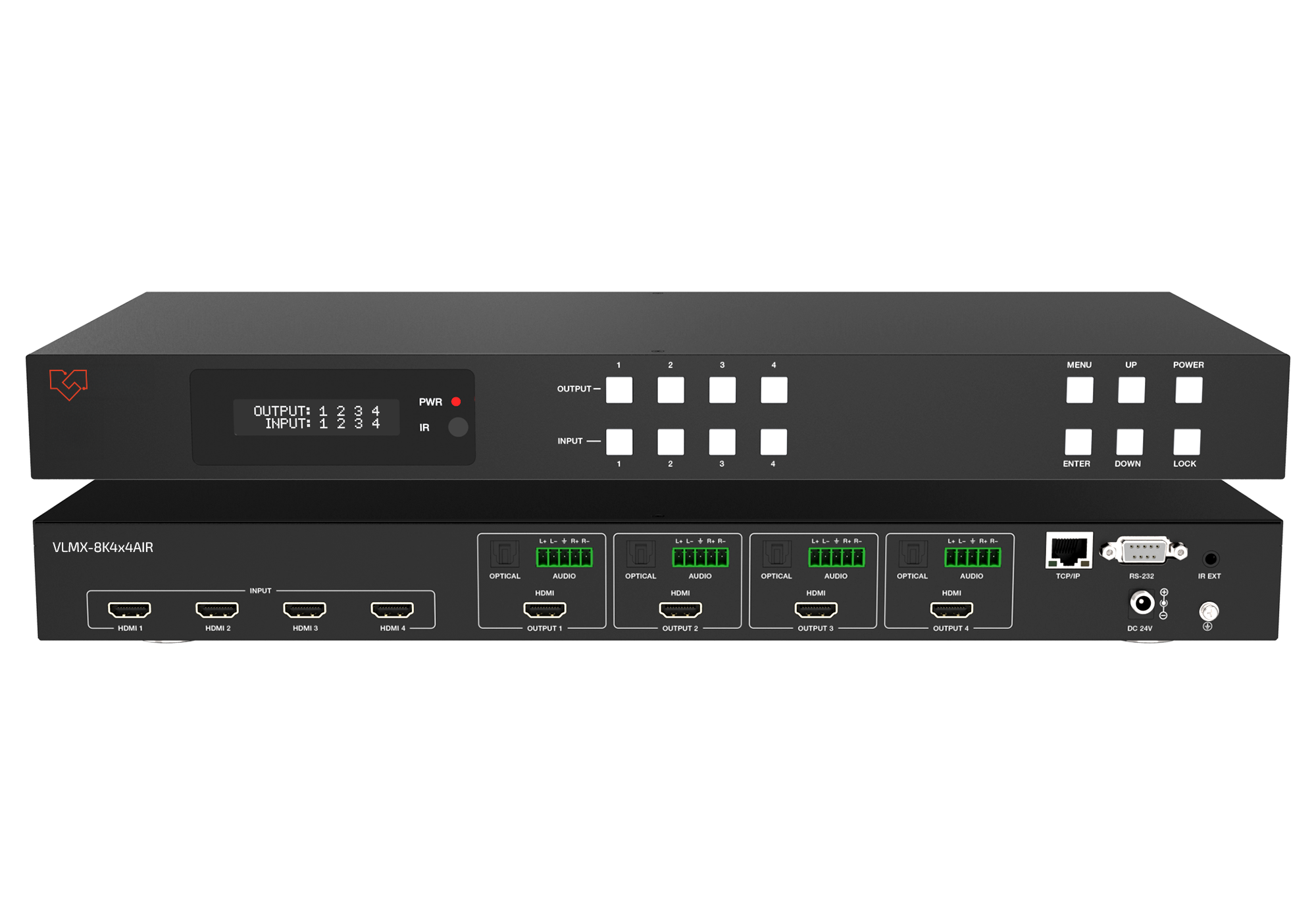
VLMX-8K4x4AIR — 4x4: Four HDMI 2.1 inputs to four HDMI 2.1 outputs, with four optical S/PDIF and four balanced analog audio outputs. Ships with a 24V/2.7A supply and draws up to 35W. Choose the 4x4 for luxury home theater, executive boardrooms, post-production suites, and compact control rooms where source and display counts stay within four.
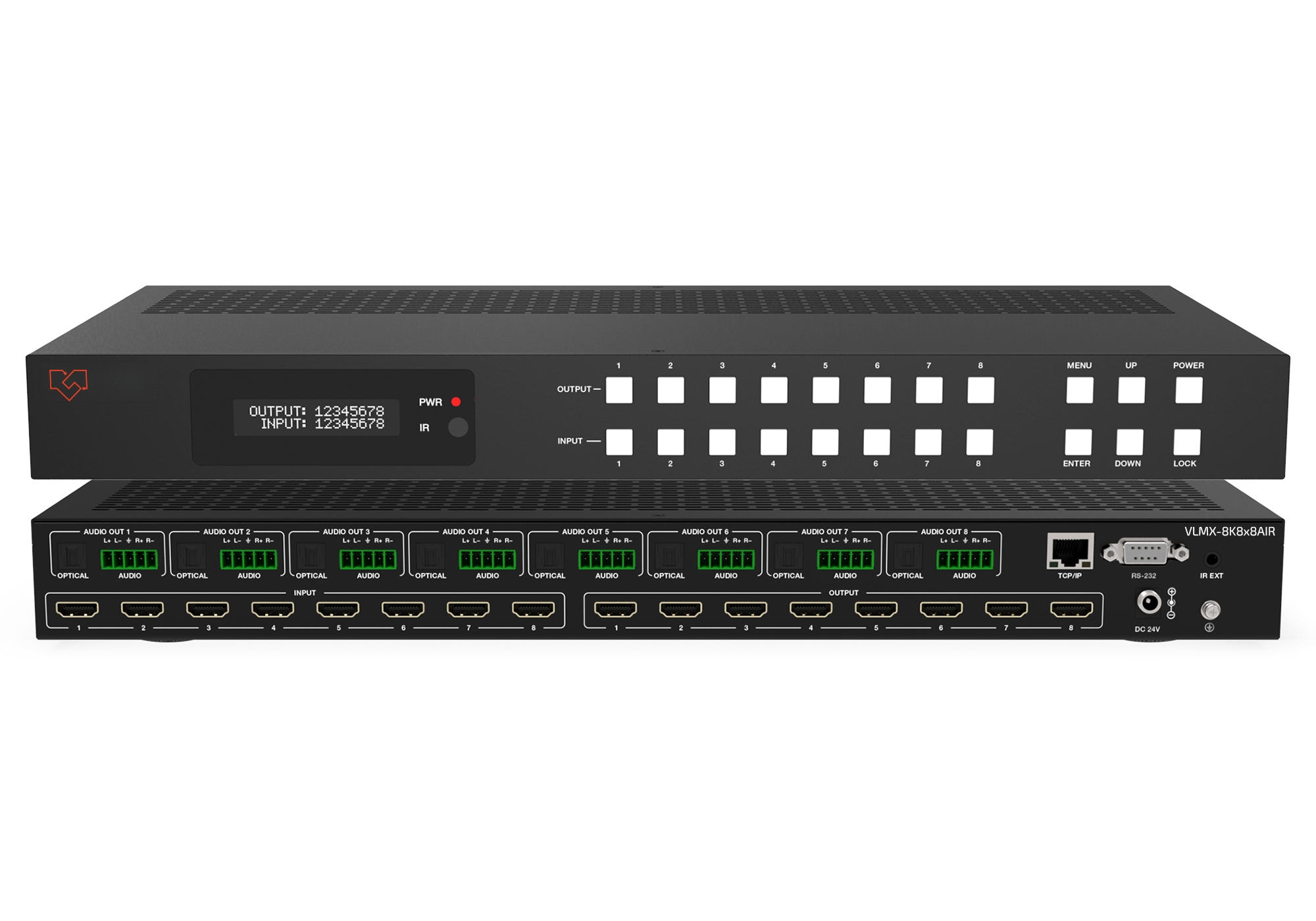
VLMX-8K8x8AIR — 8x8: Eight HDMI 2.1 inputs to eight HDMI 2.1 outputs, with eight optical S/PDIF and eight balanced analog audio outputs. Ships with a 24V/3.75A supply and draws up to 70W. Choose the 8x8 for multi-room conference centers, broadcast facilities, hospitality and sports-bar zone audio, and whole-home distribution where each of eight displays needs its own independently routed audio zone.
Shared architecture: Both models are identical in every respect other than port count and power supply. Bandwidth, resolution support, HDCP level, downscaling and HDR conversion modes, audio de-embed modes, ARC handling, EDID management, and control methods (front panel LCD, IR remote, RS-232, and Web GUI over TCP/IP) are the same across the family, and both occupy the same 1U 440mm × 203mm × 44.5mm footprint.
Frequently Asked Questions
What is audio de-embedding on a matrix switcher?
Audio de-embedding extracts the audio stream from an HDMI signal and outputs it separately, so it can be routed to an AV receiver, DSP, amplifier, or Dante bridge instead of relying on the display's speakers. On a matrix switcher, de-embedding happens on every output independently. The VLMX-8K4x4AIR and VLMX-8K8x8AIR provide one optical S/PDIF output and one balanced analog output per HDMI output, so a 4x4 unit replaces four external de-embedders and an 8x8 unit replaces eight.
Can the audio be routed separately from the video?
Yes. Both models offer three audio modes. "Bind to Input" locks each audio output to a specific HDMI input. "Bind to Output" makes audio follow whatever source is currently routed to that HDMI output. "Audio Matrix" decouples audio entirely — any input, or ARC return audio from any connected display, can be routed to any audio output independently of the video routing. This makes independent audio zones possible without a separate audio matrix in the rack.
What audio formats do the optical and analog outputs support?
The optical S/PDIF outputs carry LPCM 2.0CH and compressed Dolby or DTS 5.1CH. The balanced analog outputs on 5-pin 3.81mm Phoenix connectors carry LPCM 2CH, supporting balanced or unbalanced connection. Full multi-channel formats — Dolby Atmos, Dolby TrueHD, DTS-HD Master Audio, and DSD — pass through the HDMI outputs intact to an AV receiver or processor, since those formats exceed the bandwidth of an S/PDIF connection.
Does 8K bandwidth reduce when all outputs are in use?
No. Both models maintain the full 48Gbps HDMI 2.1 bandwidth on every input and every output simultaneously, with no bandwidth sharing as port utilization increases. All four outputs on the VLMX-8K4x4AIR — or all eight on the VLMX-8K8x8AIR — can carry 8K@60Hz 4:2:0, 8K@30Hz 4:4:4, or 4K@120Hz 4:4:4 at the same time. For reliable 8K, use Ultra High Speed HDMI 2.1 cables of 3m or less on both the input and output side.
Can I mix 8K, 4K, and 1080p displays on the same matrix?
Yes. Each HDMI output has independent resolution downscaling (bypass, 8K to 4K, 8K/4K to 1080p, or auto) and independent HDR-to-SDR conversion. A single 8K source can therefore feed an 8K display at native resolution while simultaneously feeding 4K and legacy 1080p displays with correctly scaled versions of the same content — with no external scaler required at any display. Auto mode reads the connected display's EDID and selects the appropriate output format automatically.